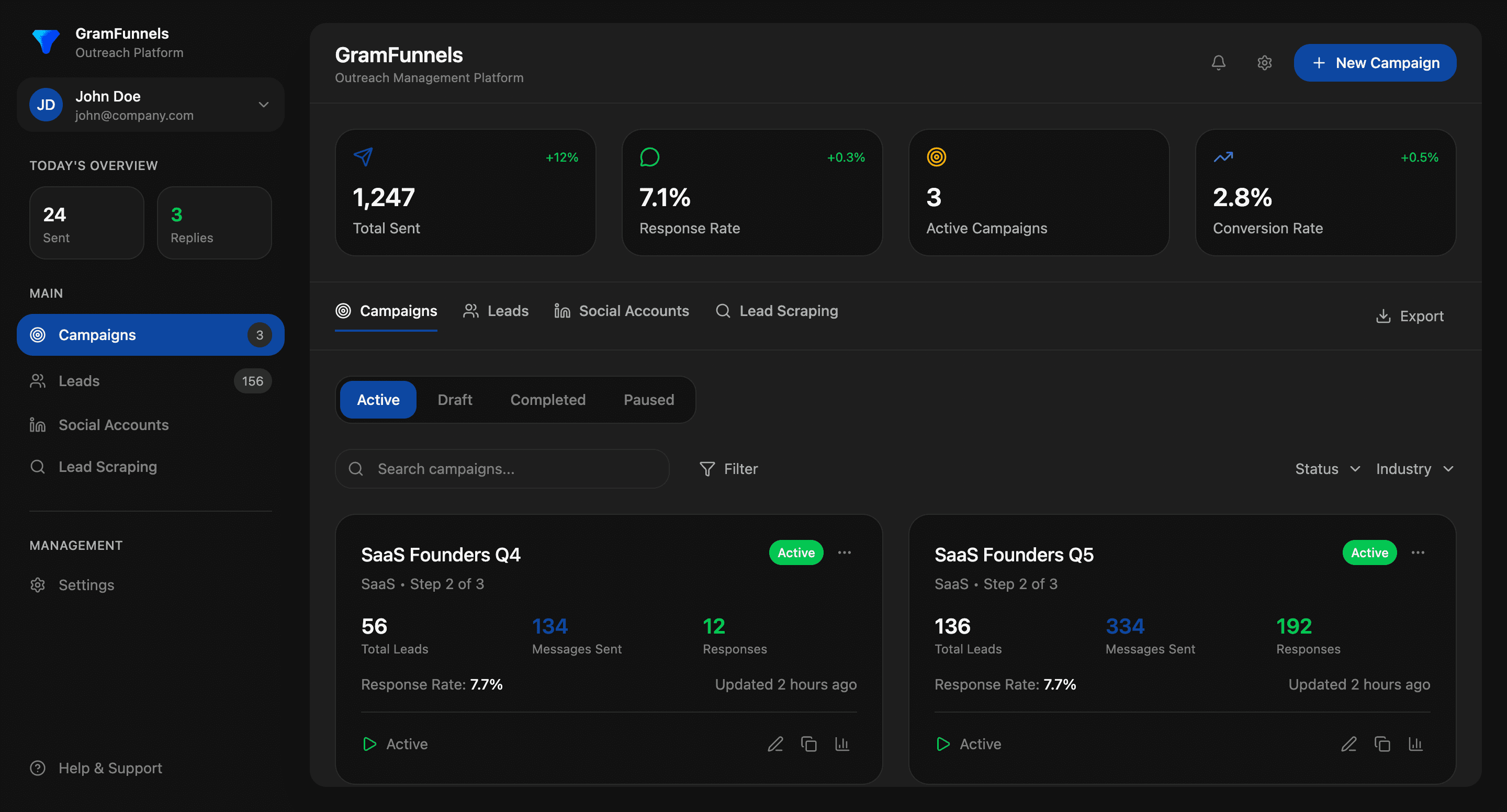
Direct message automation on X (formerly Twitter) has become the most efficient way for B2B sales teams to scale outbound prospecting. When done right, X DM automation can increase reply rates by 40-60% and reduce the time your team spends on manual outreach by up to 70%.
But here's the reality: most teams fail at X DM automation because they either over-automate (losing personalization) or under-automate (wasting time on repetitive tasks). The sweet spot? A strategic blend of automation, personalization, and compliance.
In this guide, we'll walk you through a complete X DM automation playbook that shows you how to scale your sales pipeline without triggering spam filters or damaging your brand reputation.
What Is X DM Automation and Why It Matters
X DM automation refers to using software tools to automatically send, sequence, and manage direct messages to targeted prospects on X. Unlike blast emails, DMs feel more personal and have significantly higher open and reply rates on the platform.
Here's why X DM automation matters for sales teams:
- Higher engagement: DMs have 5-10x higher open rates than traditional cold emails
- Scalability: Automate repetitive prospecting tasks while your team focuses on closing deals
- Personalization at scale: Modern automation tools allow dynamic personalization based on prospect behavior and profile data
- Compliance: Built-in safety features help you avoid account suspensions and spam filters
- Data-driven decisions: Track metrics like reply rates, conversion rates, and cost per acquisition
The key is understanding that automation isn't about removing the human element-it's about strategically automating what's repetitive so your team can focus on genuine relationship-building.
Building Your X DM Automation Strategy: The Framework
Before you implement any automation tool, you need a solid strategy. Here's the framework we recommend:
Step 1: Define Your Ideal Customer Profile (ICP)
X DM automation only works if you're targeting the right people. Spend time identifying:
- Job titles and seniority levels
- Company size and industry
- Geographic location
- Specific pain points they discuss on X
- Engagement patterns (how active they are, what content they share)
Tools like X's advanced search and automation platforms with keyword filtering make this much easier. You can use specific keywords, hashtags, and account behaviors to build highly targeted prospect lists.
Step 2: Segment Your Audience
Not all prospects need the same message. Create 3-5 audience segments based on:
- Industry vertical
- Company size
- Specific pain points
- Engagement level on X
This segmentation becomes critical when you're automating DM sequences. Each segment gets tailored messaging that speaks directly to their situation.
Step 3: Create Your DM Sequence Template
Your DM sequence is the backbone of your automation strategy. Most effective sequences follow this structure:
- Message 1 (Initial Outreach): 2-3 sentences, personalized reference, clear value prop
- Message 2 (Follow-up, 3-5 days later): Add new information or specific use case
- Message 3 (Final touch, 7-10 days later): Different angle or social proof
The key is that each message should feel natural-like a real person checking in, not a bot. Read our complete guide to DM templates and scripts that convert for copy examples you can use immediately.
Step 4: Set Automation Parameters
X DM automation requires careful planning to avoid looking spammy or triggering rate limits:
- Send volume: Start with 20-30 DMs per day, gradually increase to 50-100 as your account ages
- Timing: Space messages throughout the business day (9 AM-5 PM in prospect's timezone)
- Sequence timing: 3-5 days between first and second message, 7-10 days between second and third
- Frequency caps: Don't send more than 2-3 messages per person
These parameters help you stay well within X's rate limits while maintaining a natural cadence that respects the platform's community guidelines.
Best Practices for X DM Automation at Scale
Personalization is Non-Negotiable
The biggest mistake teams make is automating generic messages. Even with automation tools, you need personalization. Here's what high-converting DMs include:
- Specific reference: "I saw your thread on AI in sales last week-great point about..."
- Relevant pain point: "I noticed you work with B2B SaaS companies; we help teams like yours..."
- Proof of research: Show you've actually looked at their profile, not just sent a template
Tools like GramFunnels allow dynamic personalization variables based on prospect data, making it possible to personalize at scale. Learn more about personalization at scale in our detailed guide.
Monitor Deliverability and Avoid Spam Filters
X has gotten more sophisticated at detecting spammy automation. Here's how to stay safe:
- Use proxy infrastructure if managing multiple accounts to avoid IP-based rate limiting
- Vary your message language slightly across the sequence (don't send identical templates)
- Include genuine interactions-reply to tweets, engage in conversations before DMing
- Monitor your account health daily (if X flags your account, pause automation immediately)
- Never use DM automation on newly created accounts (wait 30 days minimum)
For a comprehensive overview, check our guide on avoiding spam filters with cold DM tactics.
Track the Right Metrics
You can't optimize what you don't measure. The key metrics for X DM automation are:
- Reply rate: Percentage of people who responded to your DMs (target: 10-20%)
- Conversion rate: Percentage of replies that convert to calls or demo requests (target: 5-15%)
- Cost per acquisition: Total automation tool cost divided by customers acquired
- Time saved: Hours saved through automation vs. manual outreach
Your automation tool should provide clear reporting on these metrics. If it doesn't, you're flying blind.
X DM Automation Playbook Examples
Playbook 1: B2B SaaS Sales (High Intent Prospects)
This playbook targets decision-makers actively discussing relevant pain points on X:
Message 1: "Hey [Name]-saw your recent thread on sales automation. We work with [Company Type] to reduce manual prospecting by 70%. Worth a quick chat?"
Message 2 (4 days later): "Just helped [Similar Company] cut their outreach time in half while increasing meetings booked by 40%. Happy to show you how we did it."
Message 3 (9 days later): "No pressure, but we're launching new AI-powered segmentation next week. Would be valuable for teams like yours."
This playbook works because each message adds value and addresses a specific pain point.
Playbook 2: Low-Intent Prospecting (Building Relationships)
For prospects not actively looking to buy, focus on relationship-building:
Message 1: "[Name]-loved your take on [topic]. Sent you a resource we created on [related topic] that your audience might find useful."
Message 2 (7 days later): "Found this article that connects to the point you made in [previous tweet]. Thought you'd appreciate it."
Message 3 (14 days later): "When you're thinking about [problem they mentioned], keep us in mind. We've built something specifically for that."
This playbook prioritizes genuine value and relationship-building over an immediate sell.
Playbook 4: Event-Based Outreach
Use X DM automation around events, product launches, or seasonal moments:
Trigger: Prospect mentions attending [specific conference] or tweets about [industry event]
Message 1: "[Name]-will you be at [Conference]? We'll be at booth [X]. Would be great to connect!"
Message 2 (3 days later): "Meeting at [Conference]? No pressure, but we've helped [X companies] solve [specific problem]. Happy to grab coffee if you're interested."
This approach capitalizes on timely opportunities and specific touchpoints.
Tools for X DM Automation
Several tools specialize in X DM automation. When evaluating a platform, look for:
- Keyword-based prospect targeting with X API access
- DM sequence automation with customizable timing
- Personalization variables and dynamic messaging
- Built-in compliance and safety features (rate limiting, proxy support)
- CRM integration to track leads through your sales pipeline
- Detailed analytics on reply rates, engagement, and conversions
Popular options in the X automation space include GramFunnels and other platforms built specifically for X outreach. If you're comparing tools, check out our comparison of X automation tools for sales teams to see which fits your needs.
When selecting a tool, prioritize proven deliverability, user support, and compliance features over flashy features you won't use.
Common Mistakes to Avoid
Mistake 1: Automating Without Personalization
Sending the same generic message to hundreds of people will tank your reply rates and get your account flagged. Always include at least one personalized element per message.
Mistake 2: Too Much, Too Fast
Ramping up from 0 to 200 DMs per day overnight is a recipe for suspension. Grow gradually-20-30 DMs on day one, increasing by 10-20 per week as your account proves itself.
Mistake 3: Ignoring Account Health
Monitor your account daily for warning signs: reduced reach, delayed DM delivery, or platform warnings. If something feels off, pause automation immediately and investigate.
Mistake 4: No Follow-Up Strategy
Automation handles the initial outreach, but SDRs must manage replies and conversations. Without a solid follow-up system, you'll waste leads. Set up a CRM integration to ensure every reply is captured and actioned.
Mistake 5: Using Old Account Data
If your prospect list is older than 30 days, you're reaching ghost accounts and inactive users. Refresh your targeting regularly and continuously discover new prospects based on current behaviors and conversations.
Scaling X DM Automation Safely
The biggest challenge with X DM automation is scaling without triggering spam detection. Here's our recommended scaling timeline:
- Weeks 1-2: 20-30 DMs per day, low audience (500-1000 prospects max)
- Weeks 3-4: 50-75 DMs per day, expanded audience
- Weeks 5-8: 100-150 DMs per day, multi-segment targeting
- Month 3+: 200+ DMs per day (if using multiple accounts with proxy infrastructure)
Key safety practices:
- Use proxy infrastructure for multi-account setups to distribute IP addresses
- Vary your message templates slightly across different sends
- Space sends throughout the day rather than batching
- Maintain a minimum 1% manual engagement rate (reply to tweets, retweets, likes)
- Monitor deliverability settings and account safety continuously
The rule of thumb: if you're managing multiple X accounts, use proper infrastructure. If you're managing a single account, focus on quality personalization and natural cadence.
Integration with Your Sales Process
X DM automation doesn't exist in a vacuum. It needs to integrate with your broader sales process:
- CRM integration: Every prospect you reach via DM should be logged in your CRM. Automation tools should sync replies automatically.
- Lead scoring: Not all replies are equal. Set up scoring rules so your SDR team prioritizes high-intent conversations.
- Sales workflows: Create automated workflows for common scenarios (prospect asks for pricing, prospect schedules call, prospect says "not now," etc.)
- Team collaboration: Your SDRs need clear playbooks for responding to DM replies. Document expected response times and messaging guidelines.
Learn more about CRM integrations for X outreach in our setup guide.
Measuring ROI on X DM Automation
Here's how to calculate actual ROI:
Basic Formula:
Revenue from DM-generated deals - (Tool cost + Labor cost) = Net ROI
Example (Monthly):
- Tool cost: $500
- Labor cost (2 hours/week SDR time): $400
- Total monthly cost: $900
- DMs sent: 3,000
- Reply rate: 15% (450 replies)
- Meeting rate: 20% of replies (90 meetings)
- Conversion rate: 10% (9 customers)
- Average deal value: $5,000
- Revenue: $45,000
- Net ROI: $44,100 per month (or 4,900% ROI)
Of course, your numbers will vary based on industry, ICP, and sales cycle. But this demonstrates why X DM automation can be incredibly high-ROI for B2B sales teams.
Advanced: Building Multi-Channel Outreach with X DM Automation
The most sophisticated teams don't rely on X DM automation alone. They integrate it into a multi-channel strategy:
- X DM as lead source: Use automation to identify interested prospects and warm them up
- Follow-up via email: If someone doesn't reply to DMs, hit them with a cold email sequence
- Phone outreach: For high-intent prospects, use modern cold calling techniques to close deals
- Content marketing: Share valuable content on X to build authority and increase inbound leads
This multi-channel approach significantly increases conversion rates because you're meeting prospects where they are and reinforcing your message across channels.
Getting Started with X DM Automation Today
Here's your action plan:
- Week 1: Define your ICP and create 3-5 audience segments
- Week 2: Write 3 DM templates tailored to each segment (use proven DM sequence structures)
- Week 3: Set up your automation tool with safety parameters
- Week 4: Launch pilot with 20-30 DMs per day to a small segment
- Week 5+: Monitor metrics daily, adjust based on reply rates, gradually scale
The key to success with X DM automation is starting small, measuring everything, and scaling systematically. Don't try to go from 0 to 500 DMs per day in one week. Instead, build sustainable outreach that your account (and your team) can handle long-term.
Final Thoughts
X DM automation is one of the highest-ROI prospecting channels available today-if you do it right. The difference between success and failure comes down to three factors: smart targeting, genuine personalization, and careful execution.
Teams that treat X DM automation as a volume game lose accounts and waste money. Teams that treat it as a precision instrument-combining automation with personalization and compliance-see exceptional results.
Start with the framework outlined in this guide, focus on creating templates that genuinely resonate with your ideal customers, and scale gradually as your account proves itself. Your reply rates and revenue will follow.