The holy grail of social media outreach is simple: send personalized messages to thousands of people without sounding like a robot. Yet most marketers and sales teams struggle with this contradiction. They either sacrifice conversion rates for speed, or they spend hours manually crafting individual messages to a handful of prospects.
High converting DM copy doesn't have to be a trade-off. With the right strategy, you can create messages that feel genuinely personal while maintaining the throughput needed to scale your business. This guide reveals exactly how.
The Personalization Paradox: Why Generic Copy Fails
Before we talk about solutions, let's understand the problem. A study by HubSpot found that 72% of email and DM recipients expect personalized experiences, but only 35% of marketers say they deliver it at scale. On X (formerly Twitter), where authenticity and genuine engagement matter even more, this gap is even more pronounced.
Generic DM copy performs poorly because:
- It triggers spam filters: Repetitive language patterns are flagged by X's algorithms as suspicious activity
- It kills conversion rates: Prospects immediately recognize mass outreach and disengage
- It damages your account credibility: Inauthentic messaging raises red flags that can lead to account restrictions
- It wastes your time: You're reaching people who won't respond anyway, tanking your metrics
The research is clear: personalization at scale isn't optional-it's the foundation of any high-converting outreach strategy.
Understanding High Converting DM Copy Elements
What makes a DM actually convert? There are five core elements that separate high-converting copy from the noise:
1. Relevant Hook (First Line Matters)
Your first sentence determines whether someone reads the rest or deletes your message. A relevant hook acknowledges something specific about your prospect-their recent activity, role, company, or stated interests.
Weak hook: "Hey, I thought you'd be interested in what we're doing"
Strong hook: "I saw your recent post about scaling sales teams-we've helped 200+ companies reduce sales cycles by 40%"
The difference? One shows you've done research. The other shows you're blasting messages.
2. Credibility Signal
This isn't bragging-it's social proof. Include a specific metric, client success, or relevant credential that makes your offer believable.
Examples:
- "We've worked with brands like [Company Name] and [Company Name]"
- "300+ B2B marketers use our platform to manage outreach"
- "Helped companies reduce their sales cycle from 90 to 45 days"
Specificity wins. "Helped many companies" converts worse than "Helped 47 SaaS companies increase pipeline by 35%"
3. Clear Value Proposition
What's in it for them? Not what your product does-what problem it solves or what outcome they get.
Weak: "Our automation tool sends DMs at scale"
Strong: "Get 3x more qualified replies without spending 6 hours a day on manual outreach"
4. Micro-Commitment (The Ask)
Don't ask for a sale. Ask for something small-a reply, a quick call, a look at a case study. Low-friction next steps dramatically increase conversion rates.
Weak: "Let's schedule a demo"
Strong: "Does this sound relevant? Happy to share how we've approached this with similar companies"
5. Authentic Tone
On X, formality kills engagement. Use conversational language, contractions, and a human voice. Your message should read like it came from a person, not a template engine.
Strategic Personalization Tactics for Scale
Now that you understand the elements, here's how to actually implement personalization without manually writing thousands of messages:
Layered Personalization Framework
Layer 1: Segment-Level Personalization
Divide your audience into meaningful segments before outreach:
- By role (VP of Sales, Marketing Manager, Founder)
- By company size (1-50 employees, 50-500, 500+)
- By industry (SaaS, agency, e-commerce)
- By intent signal (recent hire, job title change, posted about relevant topic)
Create one DM template per segment. This maintains genuineness while enabling scale. A message to a VP of Sales will naturally differ from one to a founder, and prospects sense when you've gotten this right.
Layer 2: Profile-Level Personalization
Insert dynamic variables that pull directly from their profile:
- First name: "Hey [first_name], I saw..."
- Job title: "As a [job_title], you're probably managing..."
- Company: "I noticed [company] recently..."
- Recent activity: "Your recent post about [topic]..."
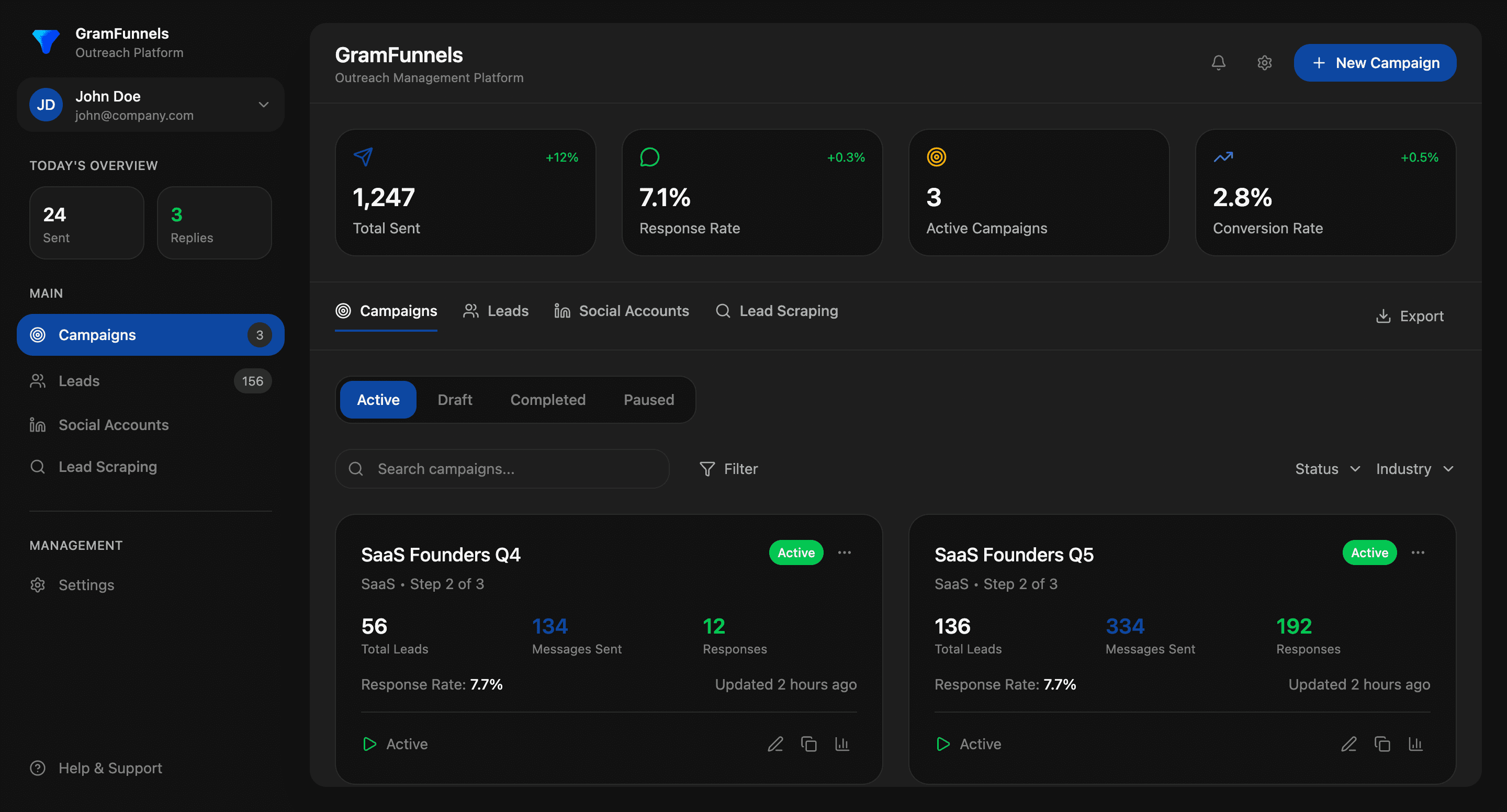
Modern tools like GramFunnels can automatically populate these fields from X profiles, ensuring every message feels individually crafted.
Layer 3: Behavioral Personalization
Personalize based on how prospects interact with your content:
- Only message people who engaged with your content (viewed tweet, liked, replied)
- Adjust your hook based on which of your tweets they engaged with
- Reference their engagement: "I saw you commented on that post about [topic]"
The "Pseudo-Personal" Formula
This framework bridges personalization and scale-without feeling inauthentic:
Structure:
- Personalized hook (segment-based + 1 profile variable)
- Specific credibility signal (metric + relevant example)
- Singular value prop (solve 1 problem, not 5)
- Social proof question (invite their perspective)
- Micro-commitment (low-friction next step)
Example for Demand Gen Managers at SaaS Companies:
"Hi [first_name]-I noticed your recent post about scaling lead gen budgets. We helped [similar company] cut their CAC by 35% while maintaining quality. The key was automating qualification without losing personalization (which most tools get wrong).
Given your focus on efficiency, worth a quick chat? Happy to share the framework they used."
This template:
- Uses 2 variables (first_name, similar company) but feels completely personal
- References their specific behavior (recent post)
- Includes a credibility signal (35% CAC reduction)
- Positions a unique angle (automation + personalization)
- Asks for nothing but conversation
Testing Your DM Copy at Scale
High converting DM copy is rarely perfect on the first draft. Here's how to optimize:
- Start small: Test each template with 50-100 prospects before scaling
- Measure reply rate: Track which hooks, value props, and CTAs get the most responses
- A/B test systematically: Change one element per variation (hook, credibility signal, or CTA) and measure the impact
- Iterate based on data: High reply rate (15%+)? Roll it out to 500 more prospects. Low rate (<8%)? Refine the copy
Pro tip: The best feedback comes from actual replies. When someone engages (even if it's a "no"), you've proven the copy worked. Pay attention to what caused the engagement.
Avoiding Common High Converting DM Copy Mistakes
Even with solid strategy, small mistakes tank conversion rates:
Mistake 1: Too Much Personalization in the Wrong Places
Over-personalizing creates uncomfortable messages that reveal you've scraped data. "Hey [first_name], I see you live in [city] and your hobby is [hobby]-" feels creepy, not personal.
Rule: Personalize to context (their role, behavior, company), not to creepy data points.
Mistake 2: Burying the Value Prop
Many marketers spend 50% of their DM space on background before explaining why the prospect should care. Flip this: lead with value, support with context.
Bad structure: "I'm a growth strategist at [Company]. We've been working in this space for 5 years. I help companies grow. I think you might benefit..."
Good structure: "We help [role] achieve [outcome]. I noticed you're working on [challenge], which is exactly what we optimize for."
Mistake 3: Asking for Too Much Too Soon
"Want to schedule a 30-minute demo?" converts 2-3% of cold prospects. "Reply with 'yes' if this sounds relevant" converts 25%+. Always start with the smallest possible ask.
Mistake 4: Ignoring Account Safety
High volume + generic copy = spam filters. Even with great personalization, you need proper automation settings. Check your rate limiting and pacing to avoid triggering X's safety systems. Learn more about X automation safety settings to protect your account while scaling.
Mistake 5: Not Following Up
A single DM converts 3-5% of prospects. A sequence of 3 DMs spaced days apart converts 15-20%. Personalize your follow-ups just as much as your first message-reference the previous conversation or explain why you're reaching back out.
Tools That Enable Personalized Outreach at Scale
The right platform makes personalization at scale actually possible. Look for tools that:
- Support dynamic variable insertion (first name, company, job title)
- Allow segment-based templates (different messages for different audiences)
- Automate DM sequencing with proper pacing
- Provide deliverability and safety features to avoid spam filters
- Track and measure reply rates for each template variation
Platforms built specifically for X outreach-like GramFunnels-are designed with these capabilities, allowing you to personalize messages at scale without manual work or account risks. They include spam filter avoidance features and reply rate optimization tools that aren't available with generic social media platforms.
Creating Your Personalization Framework
Ready to implement? Start here:
Step 1: Define Your Segments
List 3-5 distinct audience segments. Create one base template per segment (not per individual prospect).
Step 2: Identify Personalization Variables
Choose 2-3 variables that change per prospect: first name, company, recent activity, or role. Don't overload-2-3 is optimal.
Step 3: Write Your Templates
Draft one template per segment, incorporating the five core elements (hook, credibility, value prop, micro-commitment, authentic tone). Use brackets for variables: [first_name], [company], [activity].
Step 4: Test and Measure
Send each template to 50-100 prospects. Measure reply rate. Keep what works (15%+ reply rate). Refine what doesn't.
Step 5: Scale Systematically
Once a template hits 15%+ reply rate, increase volume gradually (100 → 250 → 500). Monitor for any drops in reply rate or account warnings.
The ROI of High Converting DM Copy
Let's talk numbers. A typical cold outreach campaign might look like:
- Generic copy: 5% reply rate, 1-2% meeting rate, $15 cost per meeting
- Personalized copy: 18% reply rate, 5-7% meeting rate, $4 cost per meeting
If you're reaching 1,000 prospects per month, that's the difference between 10 and 50 qualified conversations. Over a year, that's 480 additional qualified opportunities-without spending more money or reaching more people.
High converting DM copy is a direct multiplier on your sales pipeline.
Final Thoughts: Personalization Isn't Optional
The future of cold outreach is personalized or nonexistent. X's algorithm, prospect expectations, and account safety all demand genuine personalization. The good news? You don't need to choose between personalization and scale.
With a solid framework, the right variables, and proper testing, you can create DM copy that converts at 15-20% while reaching hundreds of prospects monthly. The companies doing this today are capturing market share at an unfair advantage. The longer you wait, the harder it gets to compete.
Start with one segment, one template, and 50 test prospects. Measure your reply rate. Iterate. Then scale. This systematic approach to personalization is how the best founders and sales teams are actually building pipeline in 2025.
For more advanced strategies on building full outreach sequences, read our guide on DM sequences and cadence. To understand the technical side of safe, compliant scaling, explore safe automation settings for personalization at scale.