DM Templates & Scripts: Copy-Paste Cold Outreach That Converts
Cold direct messages on X are one of the most effective ways to generate qualified leads and book sales meetings-but only if you get the template right.
The difference between a DM that gets ignored and one that converts often comes down to a few critical elements: relevance, brevity, and a clear value proposition. Too many marketers send generic messages that get filtered into "Other" folders or deleted outright.
This guide provides battle-tested DM templates, cold DM scripts, and follow-up sequences that actually work. You'll discover the exact frameworks used by founders and sales teams generating millions in pipeline through X outreach, plus tactical variations you can customize for your business.
Why DM Templates Matter for Cold Outreach
Before diving into specific templates, let's understand why structure and templates are critical to outreach success.
According to research from Outbound.io, personalized cold outreach sees a 40% higher response rate compared to generic messages. However, true personalization at scale is nearly impossible without templates as your foundation.
Here's why templates work:
- Consistency: Templates ensure your core value proposition is communicated the same way across all outreach, which helps you test and refine messaging more effectively.
- Speed: Your team can send more outreach in less time when you're not rewriting every message from scratch.
- Scalability: With templates, you can manage multi-person outreach campaigns and maintain quality across all team members.
- Testing: Templates make A/B testing easier. Change one variable, measure results, and optimize systematically.
The key is using templates as a starting point for personalization, not as a final product. A good template should include variable placeholders for the prospect's name, company, specific trigger events, or custom details.
Cold DM Scripts: The Anatomy of High-Converting Messages
Every effective cold DM follows a specific structure. Let's break down what makes a message convert.
The 5-Part Cold DM Framework
Successful cold DMs typically follow this structure:
- The Hook: Your first line must grab attention and make the reader want to continue. This is typically 2-3 words that reference something specific about them.
- The Context: Why are you reaching out? What do you know about them or their situation?
- The Value: What's in it for them? What problem do you solve or what opportunity are you presenting?
- The Social Proof: A brief mention of similar results or satisfied customers (optional but powerful).
- The Call to Action: What do you want them to do next? Keep it simple: reply, click a link, or schedule a call.
Example 1: The Curiosity-Driven Cold DM
Best for: High-ticket B2B services, consulting, agencies
Hey [First Name],

Saw your post about [specific recent tweet/activity]. Impressive.

I've noticed companies in [industry] are losing $[X] annually due to [specific problem].

We helped [similar company] reduce that by [%] in [timeframe].

Might be worth a quick conversation?

[Link or calendly]
This template works because:
- The hook is immediate and specific (references their actual recent activity)
- It quantifies the problem (anchors them with a big number)
- It provides proof (mentions similar results)
- The CTA is low-friction ("might be worth a conversation")
Example 2: The Direct Problem-Solving Script
Best for: SaaS, software tools, technical services
Hi [First Name],

Noticed you're leading growth at [Company]. Most teams like you struggle with [specific challenge-e.g., email deliverability].

We built a tool that solved this for [Competitor/Similar Company], increasing their [relevant metric] by [%].

Worth exploring?

[Link]
Why this works:
- Immediately identifies their role and pain point
- Uses social proof (another recognized company)
- Focuses on the outcome that matters to them
- No fluff-straight to value
Example 3: The Trigger-Based Approach
Best for: Sales development, opportunity creation
Hey [First Name],

Saw [Company] just launched [product/feature/funding announcement]-congrats.

Funny timing. I was actually just working with [similar company] on exactly this.

They found [specific benefit] when they [action].

Quick thought that might help if interested.
This is powerful because:
- It's timely and relevant (based on a recent event)
- It shows you've done research specific to them
- It positions you as knowledgeable without being pushy
Follow-Up Scripts: Converting Non-Responders
Your first DM is just the beginning. Most sales happen on the third, fourth, or fifth touch. Here are effective follow-up scripts.
Follow-Up #1 (3-5 Days Later)
Hey [First Name], just making sure this landed in your inbox.

No rush-genuinely just wanted to see if [specific benefit] was relevant to your team right now.

Let me know if it's worth a 15-minute call or if timing's just off.
This follow-up assumes they simply didn't see the first message. It's casual, doesn't guilt-trip, and makes opting out easy ("if timing's just off").
Follow-Up #2 (1 Week Later)
Quick question for you [First Name],

When you think about [their biggest challenge], what's blocking you most right now?

Asking because we've found [insight] with other teams like yours.

Might be helpful regardless-happy to share without any expectation.
This reframes the conversation away from your product and toward their problem. It positions you as a helpful resource, not a salesperson.
Follow-Up #3 (2 Weeks Later): The Soft Close
Hey [First Name],

Last one from me-don't want to be annoying.

If you're interested in exploring [solution], I've got two 15-min slots this week.

If not, genuinely no hard feelings. Good luck with everything.
This is your last touch before they're "nurture" only. It acknowledges that you've already reached out multiple times and gives them a graceful exit while still leaving the door open.
Objection Handling Scripts: When Prospects Push Back
Not every response is positive. Here's how to handle common objections in DM format.
"We already use [competitor]"/"Not interested"
Totally fair. Most teams have something in place already.

The only reason I reached out-we typically see [specific benefit] that [competitor] doesn't handle.

Not saying you should switch, but might be worth 15 mins to see if it applies?

If not, genuinely wish you the best.
Instead of defending your product, you acknowledge their existing solution and focus on a specific differentiation point.
"Too expensive"/"Not in budget"
I get it-budget's tight for everyone right now.

Just to clarify: we actually work with companies [similar size/stage] and usually the ROI covers the cost in [timeframe].

Would it make sense to just see the numbers? No commitment.
This addresses the objection head-on by introducing ROI without being defensive.
"Send me more info"
Happy to. Just so I send the right stuff-what's your biggest priority right now?

[Option A: Improving X]
[Option B: Reducing Y]
[Option C: Something else?]

That way I can skip the generic deck.
Instead of sending a one-size-fits-all PDF, you qualify their need first. This increases the chance they'll actually review what you send.
Advanced DM Tactics: Personalization at Scale
Templates are powerful, but personalization makes them convert. Here's how to personalize systematically without losing efficiency.
1. Research-Based Personalization
Before sending any DM, spend 60 seconds on each prospect:
- Check their recent tweets-find something specific to reference
- Look at their company's latest news (funding, hires, product launches)
- Identify one specific challenge related to your solution
Example: Instead of "Saw your post about growth," write "Saw you mentioned struggling with email deliverability in your May post."
2. Use Variable Placeholders in Your Template
Set up templates with clear placeholders:
[HOOK: Specific reference to their recent activity]
[CONTEXT: Why you're reaching out to THEM specifically]
[OFFER: The value you provide]
[PROOF: A relevant result or case study]
[CTA: Next step]
Fill these in for each prospect. The template structure stays consistent, but the details change.
3. Reference Their Specific Metrics
If you can find it, mention a metric they care about:
"Noticed you've been focused on growing ARR-we help B2B companies like yours increase annual contract value by [%]..."
This shows you've done research and understand their business model.
4. Mention Mutual Connections (When Applicable)
"[Mutual contact] mentioned you'd appreciate a heads up on this. I'm reaching out because..."
This increases credibility significantly if you actually have a warm introduction or mutual connection.
Building a DM Sequence Cadence
A single DM is rarely enough. The most successful outreach uses strategic sequencing. Learn more about this in our DM Sequences and Cadence guide.
Here's a basic high-converting sequence framework:
- Day 0 (Tuesday-Thursday): Send your initial cold DM
- Day 3-5: First follow-up (soft touch, doesn't guilt-trip)
- Day 10-14: Second follow-up (shift focus to their problem, not your solution)
- Day 21: Final follow-up (graceful exit, door stays open)
- Day 45+: Move to nurture sequences or email if you have their email
For a detailed breakdown of timing and conversion optimization, check out our Sales Sequences on X guide.
Common Cold DM Mistakes to Avoid
Even with a great template, these mistakes tank conversion rates:
1. Being Too Salesy
❌ Don't: "Our platform solves X, Y, Z. Check out these features..."
✓ Do: "Most teams struggle with X. We've found that Y leads to Z% improvement."
2. Making It Too Long
X DMs have character limits and attention spans are short. Keep initial outreach to 2-3 short paragraphs maximum.
3. Generic Hooks
❌ Don't: "Saw your profile, impressed with what you're doing."
✓ Do: "Saw your post about AI in sales-love that you mentioned the deliverability issue."
4. No Clear CTA
Always be explicit about what you want them to do: reply, click a link, book a call. Ambiguity kills conversions.
5. Not Testing Variables
A/B test your hooks, value propositions, and CTAs. What works for one audience might not work for another.
Tools & Automation for DM Templates
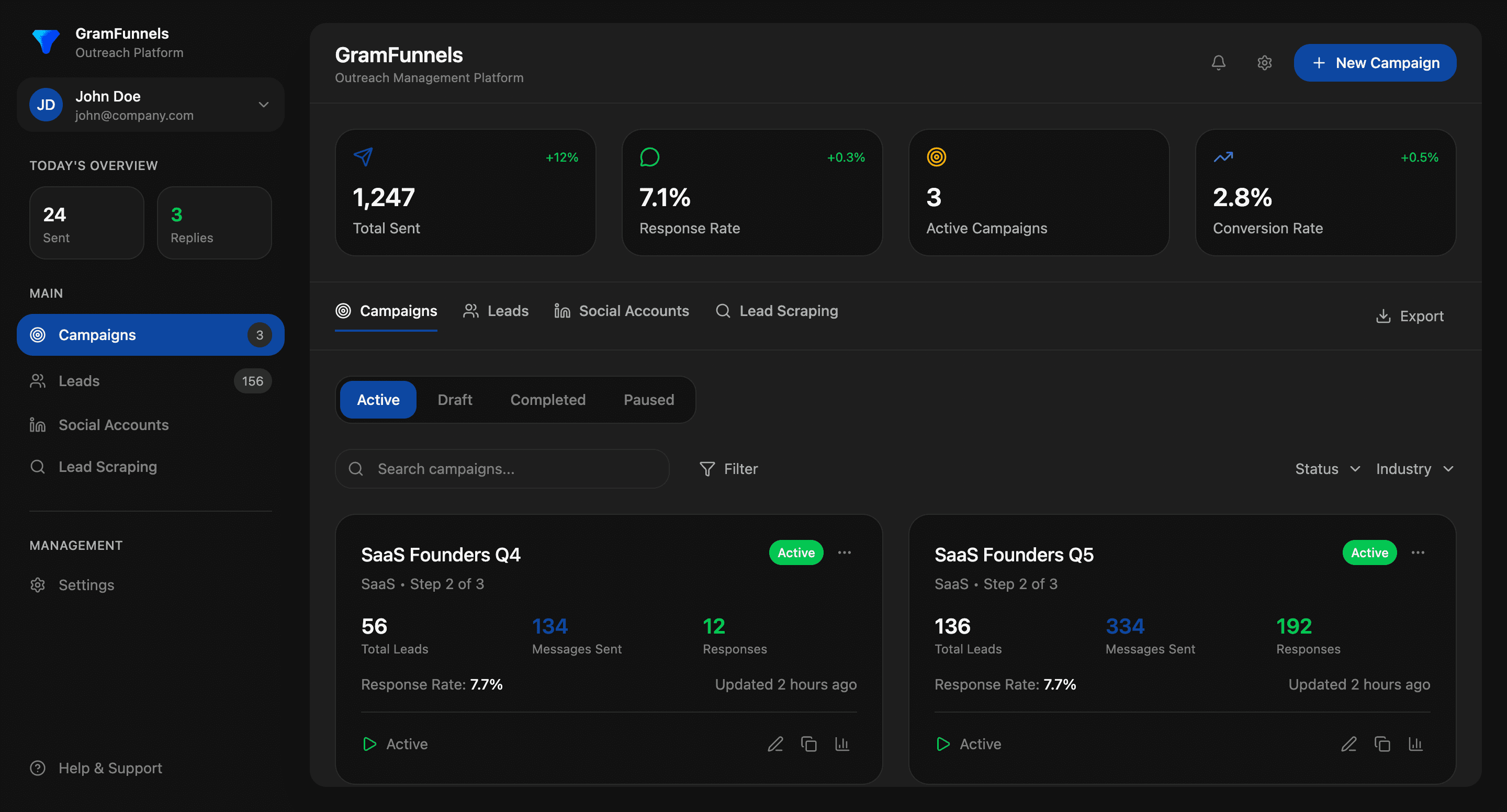
While templates are powerful, automation makes them scalable. GramFunnels enables you to send personalized DMs at scale with template variables, AI-powered customization, and built-in follow-up sequences.
Learn more about automating your DM outreach in our guide to automating social media outreach, and explore how to integrate your X outreach with your CRM to track results and pipeline.
Measuring Your Template Performance
The only way to improve your DM templates is to measure what works. Track these metrics:
- Open/Read Rate: What % of your DMs are actually being read?
- Reply Rate: What % of people reply (positively or negatively)?
- Positive Reply Rate: What % of replies show genuine interest?
- Click-Through Rate: If you include a link, how many click?
- Meeting Booking Rate: What % of conversations lead to scheduled calls?
For a comprehensive breakdown of what to measure, read our DM Strategy Guide: Metrics & KPIs.
Template Library: Ready-to-Use Scripts for Common Scenarios
For SaaS Companies
Hey [First Name],

Just noticed [Company] is [specific trigger-hiring, raising, launching feature].

We help B2B SaaS companies like you reduce [specific metric] by [%]. Helped [example company] do it in [timeframe].

Could be a quick win. Worth 15 mins?

[Link]
For Agencies
Hi [First Name],

We work with agencies scaling to [revenue goal]. Most are losing [%] of potential revenue on [specific problem].

Few conversations with us usually unlock [specific benefit].

Let me know if exploring this makes sense.

[Link]
For B2B Services/Consulting
[First Name],

Ran into [person] who works with you. Got talking about [challenge common in their industry].

They mentioned you were dealing with exactly that. Might be worth a conversation-we've solved this for [similar role/company].

No pressure, but happy to brainstorm.

[Link]
For Recruitment/Hiring
Hey [First Name],

Saw [Company] is hiring for [role]. Great timing-we've been placing [type of roles] consistently.

We've got [X] candidates who are perfect fits for your [department].

Might save you weeks of sourcing. Worth a quick call?

[Link]
Compliance & Safety Considerations
As you scale your DM outreach, it's critical to follow X's automation guidelines. Read our comprehensive guide on Compliance Best Practices for Cold DM Outreach on X to ensure you're staying within platform limits and protecting your account.
Final Thoughts: Templates Are Just the Foundation
The templates and scripts in this guide work-but only if you treat them as starting points, not final products. The most successful cold outreach combines:
- Proven template structure (consistency)
- Specific personalization (relevance)
- Systematic sequencing (persistence)
- Constant testing and iteration (improvement)
Start with the templates above, customize them for your industry and offer, and commit to testing at least 2-3 variations. After 100-200 outreach attempts, you'll have clear data on what resonates with your audience.
Ready to implement these templates at scale? Explore how GramFunnels compares to other cold DM tools and discover how automation can amplify your template strategy while maintaining the personal touch that drives conversions.