Cold DM Scripts for Founders: Convert Prospects Into Calls
Cold DM scripts are the backbone of founder-led sales on X. But here's the truth: most founders send the same generic message to dozens of prospects and wonder why their response rate is 2%.
The difference between a script that converts and one that gets ignored comes down to personalization, timing, and structure. This guide breaks down exactly how to write cold DM scripts that land meetings, including real templates you can use today.
Why Cold DM Scripts Matter for Founders
Before diving into the mechanics of cold DM scripts, let's establish why they matter.
Direct messages on X are one of the highest-intent channels for outreach. Unlike tweets that disappear in feeds, a DM lands directly in someone's inbox. According to research from Twitter's business insights, DM response rates average 30-50% higher than public mentions when done correctly.
For founders specifically, cold DMs offer several advantages:
- Direct access: You're reaching prospects one-on-one, not competing in a crowded feed
- Warm touch: A personalized DM feels more human than a cold email
- Speed: You can send dozens of targeted messages in minutes with the right approach
- Real-time engagement: You see responses immediately and can adjust strategy on the fly
But the key phrase is "done correctly." A poorly written cold DM script will tank your response rates faster than you can say "unfollow."
The Anatomy of a Cold DM Script That Converts
A high-converting cold DM script follows a specific structure. It's not about being fancy-it's about being strategic.
The 4-Part Framework:
- Hook: Grab attention in the first line (personalization or insight)
- Context: Explain why you're reaching out (specific and relevant)
- Value: Show what's in it for them (not what's in it for you)
- Call-to-action: Make the next step obvious (one clear ask)
Let's break each down:
1. The Hook: Personalization That Actually Works
Generic cold DM scripts start with things like "Hey, I noticed you work in marketing..." No. Stop.
A real hook references something specific about the person. This could be:
- A recent tweet or thread they posted
- A specific achievement or milestone
- A company announcement or product launch
- A mutual connection or interest
Example Hook (Generic): "Hey, I saw you work in SaaS sales"
Example Hook (Specific): "Your thread on ACV compression last week nailed it-especially the part about feature-first selling"
The specific hook takes 30 seconds longer to write but multiplies your response rate. This is where most founders fail. They treat cold DM scripts as assembly line work when they should be surgical.
2. The Context: Why You're Reaching Out
After the hook, tell them why you're messaging. This is not about what you do-it's about why them, specifically.
Example Context (Weak): "I run a sales automation tool and thought you might be interested"
Example Context (Strong): "I built a tool that helps teams like yours reduce manual follow-up time. Based on your thread, I thought this might be relevant to the workflow changes you're making"
Notice the difference? The strong version ties your tool directly to their pain point. You're showing that you understand their world.
3. The Value: What They Actually Get
This is where founders mess up. They lead with "we help companies do X" when prospects don't care about you-they care about themselves.
Frame the value around the prospect's world, not your features:
Example Value (Weak): "Our tool automates DM outreach and integrates with your CRM"
Example Value (Strong): "Most teams we work with find an extra 3-5 hours per week they can redirect toward strategy instead of manual follow-ups"
The strong version is specific (3-5 hours), relevant (strategy focus), and outcome-focused (time savings). This is a value prop, not a feature dump.
4. The Call-to-Action: Make It Stupid Simple
Don't ask for a 30-minute call. Don't ask them to book a demo. Ask for the smallest next step.
Example CTA (Weak): "Want to schedule a call to learn more?"
Example CTA (Strong): "Quick question: are you currently evaluating ways to reduce manual outreach work?"
The strong CTA is a yes/no question. It's easy to answer. It's not pushy. And it creates a natural follow-up conversation.
Cold DM Script Templates You Can Use Today
Here are three cold DM script templates, ready to customize:
Template 1: The Problem-First Script
Use this when you've identified a specific pain point from their public activity
"Hey [Name], saw your recent post about [specific problem]. We've worked with [similar companies] on the exact same challenge, and usually find [specific insight].
Curious if that resonates with what you're seeing?"
Why it works: It leads with their pain (not your solution), shows social proof (similar companies), and ends with a question. Low friction.
Template 2: The Mutual Connection Script
Use this when you have a warm referral or mutual contact
"Hey [Name], [Mutual contact] mentioned you're thinking about [relevant goal]. He thought our approach to [your specialty] might be worth a conversation.
Worth 15 minutes to see if it's relevant?"
Why it works: It borrows trust from a third party. The referrer has already warmed them up. This script just confirms interest.
Template 3: The Specific Result Script
Use this when you have concrete metrics from similar prospects
"Hey [Name], quick context: we recently helped [similar company] reduce their sales cycle from [X] to [Y]. They were in a similar position to you on [specific metric].
Would it make sense to spend 20 min to walk through what we did?"
Why it works: Specificity breeds credibility. "Reduced sales cycle from 45 to 30 days" is more believable than "helped companies sell faster."
Common Cold DM Script Mistakes to Avoid
Even with solid templates, founders make recurring mistakes. Here's what kills response rates:
Mistake 1: Being Too Long
A cold DM script should be 2-3 sentences max. Think of it like a text message, not an email. If your prospect has to scroll, you've lost them.
Length test: If your cold DM doesn't fit in the preview window on most phones, it's too long.
Mistake 2: Talking About Your Company First
"We're a Y Combinator-backed startup that helps teams streamline sales workflows..." No. Nobody cares. Start with them.
Mistake 3: Using Emoji and Salesy Language
"Hey fam! 🚀 Excited to connect..." This screams spam. Founders should sound like founders-professional, direct, real.
Mistake 4: No Clear Next Step
"Let me know if you want to chat" is vague. "Does Thursday or Friday work for 15 minutes?" is specific. Always give them an easy yes/no question.
Mistake 5: Sending Without Personalization
This is the biggest mistake. If your cold DM script could be sent to 500 people unchanged, it's not personal enough. The hook must be specific to the individual.
Scaling Cold DM Scripts Without Sounding Robotic
Here's the founder's dilemma: you want to send hundreds of cold DMs, but each one needs to feel personal. How do you scale without sacrificing authenticity?
The answer is systematic personalization. You build templates with placeholder fields that you customize based on research.
Here's the process:
- Identify your ICP (Ideal Customer Profile): What company size, role, and industry are you targeting?
- Create 3-5 research buckets: Find common pain points across your target audience
- Build a cold DM script variant for each bucket: Different hooks, same structure
- Research each prospect for 90 seconds: Find one specific detail to personalize the hook
- Send the script with that one personalization: Now it's both scalable and personal
For example, if your ICP is "B2B SaaS founders with 20-50 employees," your research might reveal three common pain points:
- Struggling to hire sales teams
- Can't afford enterprise sales tools
- Spending too much time on manual outreach
Create a cold DM script variant for each pain point. Then, when you research a prospect, identify which bucket they fall into and send the relevant script with one personal hook.
This approach lets you send 50+ personalized cold DMs per day without sounding like a bot.
Tools and Automation for Cold DM Scripts
Once you've written solid cold DM scripts, the next question is how to send them at scale. Manual sending won't work if you're serious about founder-led sales.
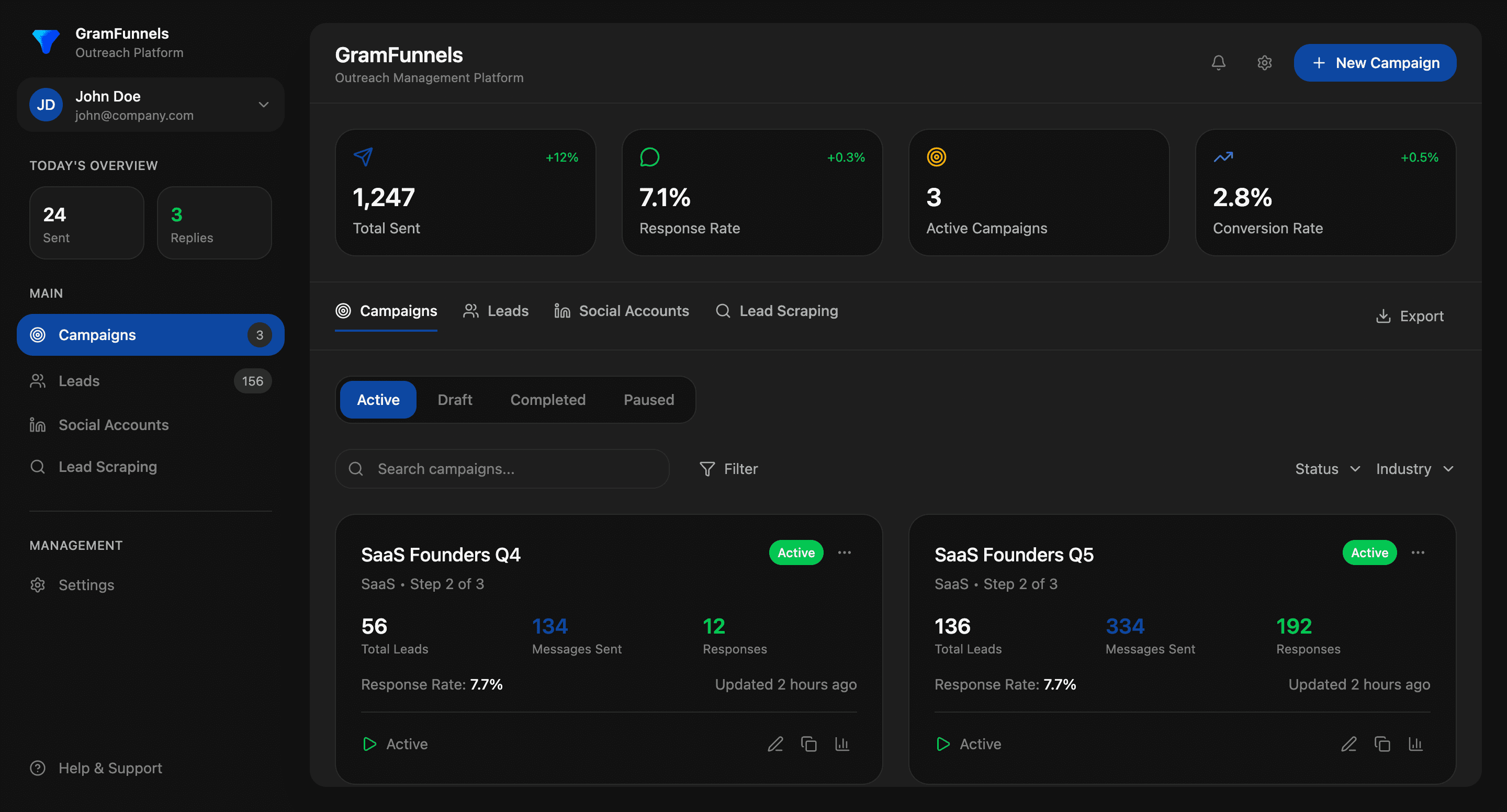
This is where X outreach automation tools come in. Platforms like GramFunnels let you:
- Set up keyword targeting to find prospects automatically
- Schedule cold DM scripts to send at optimal times
- Maintain inbox deliverability with smart rate limiting
- Track response rates and engagement metrics
- Integrate with your CRM to manage leads end-to-end
If you're looking to automate cold DM scripts responsibly, check out our complete guide on cold DM scripts that convert on X and our DM templates and scripts guide for copy-paste examples.
For those scaling to multiple team members, our guide to running multi-account outreach safely covers compliance and account safety as you grow your outreach operation.
Measuring Cold DM Script Performance
A cold DM script is only as good as the results it generates. Here's what to track:
Response Rate
What percentage of cold DMs get a reply? A 10-15% response rate is solid. Anything above 20% means you've nailed your targeting and personalization.
Conversation Quality
Are people responding positively or just asking "who is this?" Read your responses. Are they engaging or dismissing?
Call Booking Rate
How many conversations convert to actual meetings? This is the metric that matters most. A 30% conversation-to-call rate is excellent.
Deal Closure Rate
Ultimately, do these cold DM scripts lead to customers? Track which cold DM scripts lead to the highest-value deals.
A/B Testing Tip: Test one variable at a time. Change the hook in Script A vs. Script B while keeping the CTA identical. Run for 50+ sends each, then compare response rates.
Final Thoughts: Cold DM Scripts Are a Skill
Writing cold DM scripts that convert is not luck. It's a skill that improves with practice and data.
Start with specificity over volume. Send 10 highly personalized cold DMs and track which hooks work best. Then systematize those winners into templates. As you scale, maintain the personalization discipline-that's what separates response rates of 5% from 15%.
The founders winning on X right now are not sending more cold DMs than everyone else. They're sending better cold DM scripts with tighter personalization and clearer value propositions.
Use these templates. Test them. Track the results. And build a repeatable founder-led sales process that actually works.