Outbound sales can transform your business landscape. Explore its meaning, strategies, and benefits to boost your sales success and foster growth.
For many B2B companies, waiting for leads to come to you isn't enough. While inbound marketing has its place, outbound sales remains one of the most direct and controllable ways to generate revenue. When executed correctly, outbound sales allows you to identify your ideal customers, reach them at scale, and create predictable pipeline growth.
Yet despite its proven effectiveness, outbound sales is often misunderstood or poorly executed. Many sales teams struggle with low response rates, inefficient processes, and difficulty measuring ROI. This comprehensive guide breaks down what outbound sales really means, explores proven strategies that work in today's market, and shows you how to build a system that consistently generates qualified opportunities.
What is Outbound Sales?
Outbound sales is a proactive sales approach where your team initiates contact with potential customers rather than waiting for them to discover your business. Unlike inbound sales, where prospects come to you through content marketing, SEO, or referrals, outbound involves actively identifying target accounts and reaching out to decision-makers directly.
In practical terms, outbound sales includes activities like:
- Cold calling potential customers who fit your ideal customer profile
- Sending personalized cold emails to targeted prospects
- Connecting with decision-makers on LinkedIn and starting conversations
- Attending industry events and initiating face-to-face conversations
- Using direct mail campaigns to reach high-value accounts
The fundamental principle of outbound sales is control. You decide who to target, when to reach out, and what message to deliver. This level of control makes outbound particularly valuable for businesses that:
- Have a clearly defined ideal customer profile
- Operate in niche markets where prospects aren't actively searching
- Need predictable revenue growth on a specific timeline
- Want to test new markets or product offerings quickly
- Have complex solutions that require education and consultation
Modern outbound sales has evolved significantly from the aggressive cold-calling tactics of the past. Today's best practices emphasize research, personalization, and value delivery. The goal isn't to interrupt people with a pitch, but to start relevant conversations with prospects who genuinely need what you offer.
The Importance of Outbound Sales in Today's Market
Despite predictions that inbound marketing would make outbound obsolete, the reality is quite different. Outbound sales remains critically important for B2B companies, and for several compelling reasons.
Speed to Market: When you launch a new product or enter a new market, you can't afford to wait months for inbound leads to materialize. Outbound sales allows you to generate conversations and validate product-market fit within weeks, not quarters. This speed advantage is crucial for startups and companies in competitive markets.
Market Saturation: As more companies invest in content marketing and SEO, the inbound landscape has become increasingly crowded. Standing out organically takes significant time and resources. Meanwhile, a well-executed outbound campaign can reach decision-makers directly, cutting through the noise.
Target Account Precision: Not all customers are created equal. Account-based strategies require you to focus on specific high-value prospects. Outbound sales gives you the precision to target exactly the companies and individuals you want to work with, rather than accepting whoever happens to find you.
Predictable Pipeline: One of outbound sales' greatest strengths is predictability. When you know your conversion rates at each stage, you can calculate exactly how many outreach activities you need to hit revenue targets. This mathematical approach to pipeline generation gives sales leaders confidence in their forecasts.
Competitive Advantage: Your competitors are solving the same problems for the same customers. Waiting for prospects to discover you means competing on crowded battlegrounds. Proactive outreach allows you to reach decision-makers before they enter an active buying cycle, positioning yourself as a trusted advisor rather than one option among many.
According to research from TOPO, 70% of B2B buyers are open to hearing from new providers, but they won't necessarily seek them out. This represents a massive opportunity for companies willing to make the first move through thoughtful, relevant outbound sales efforts.
Key Differences Between Outbound and Inbound Sales
Understanding the distinction between outbound and inbound sales is essential for building a balanced go-to-market strategy. While both approaches aim to generate revenue, they differ fundamentally in methodology, timeline, and resource requirements.
Initiation and Control
In inbound sales, prospects initiate contact after discovering your content, website, or brand through search engines, social media, or referrals. You respond to interest that already exists. In outbound sales, your team initiates contact with prospects who may not be actively looking for a solution. This gives you greater control over who you target and when you reach them.
Timeline and Speed
Inbound strategies typically require months to build momentum. You need to create content, optimize for search engines, build domain authority, and nurture an audience before leads start flowing consistently. Outbound sales can generate conversations within days of launching a campaign. This makes it ideal for businesses that need immediate pipeline or want to test new markets quickly.
Lead Quality and Intent
Inbound leads often exhibit higher buying intent because they've actively searched for solutions and engaged with your content. However, they may not fit your ideal customer profile perfectly. Outbound allows you to target prospects who match your exact criteria, but they may not be actively shopping for a solution. The key is identifying signals that indicate potential interest or need. Learning how to identify high-intent buyer signals can dramatically improve outbound results by helping you reach prospects at the right moment.
Scalability and Resources
Inbound sales scales more efficiently over time. Once you've built strong organic visibility, leads continue flowing without proportional increases in effort. Outbound sales typically requires ongoing activity to maintain pipeline. However, modern technology and automation have made outbound significantly more scalable than in the past.
Message Control
With inbound, prospects form opinions about your brand based on the content they discover. You influence but don't control the journey. With outbound, you control the initial message, positioning, and narrative. This is particularly valuable when selling complex or innovative solutions that require education.
Cost Structure
Inbound often requires significant upfront investment in content creation, SEO, and marketing automation before generating returns. Outbound has more predictable costs tied directly to activity levels. Neither is inherently cheaper; the optimal choice depends on your specific situation, resources, and timeline.
The most successful B2B companies don't choose between inbound and outbound. They integrate both approaches, using outbound to target high-value accounts and fill immediate pipeline needs while building long-term inbound engines for sustained growth.
Effective Outbound Sales Strategies
Success in outbound sales requires more than persistence. The most effective strategies combine targeting precision, personalized messaging, and multi-channel engagement. Here are proven approaches that drive results.
Ideal Customer Profile and Targeting
Everything in outbound sales starts with knowing exactly who you're trying to reach. Your Ideal Customer Profile (ICP) should go beyond basic demographics to include behavioral and situational factors. Consider:
- Company characteristics: Industry, size, revenue, growth stage, technology stack, and geographic location
- Decision-maker attributes: Role, seniority, responsibilities, and pain points
- Situational triggers: Recent funding, leadership changes, expansion plans, or technology adoption
- Behavioral signals: Engagement with specific content, job postings, or competitive mentions
The more specific your ICP, the more relevant your outreach can be. Rather than targeting all "marketing directors," focus on "marketing directors at 50-200 person SaaS companies who recently hired a demand gen manager and are actively posting about pipeline challenges."
Intent-Based Prospecting
The evolution of outbound sales is moving toward intent-based targeting. Instead of cold outreach to strangers, focus on prospects already showing buying behavior. Modern LinkedIn high intent signals include engagement with competitor content, searches for solution-related keywords, participation in relevant discussions, and follows of industry thought leaders.
When you reach out to someone already researching solutions in your category, you're entering an active conversation rather than starting one from scratch. This dramatically improves response rates and shortens sales cycles.
Multi-Channel Sequencing
Relying on a single channel limits your reach and effectiveness. The most successful outbound campaigns use coordinated sequences across multiple touchpoints:
- Email: Personalized messages that reference specific challenges or opportunities
- LinkedIn: Connection requests with context, followed by value-adding messages
- Phone: Strategic calls at key points in the sequence to break through digital noise
- Video: Personalized video messages that stand out in crowded inboxes
- Direct mail: Physical items sent to high-value accounts for maximum impact
A typical sequence might include 8-12 touchpoints over 3-4 weeks, varying channels and message angles to maintain interest without becoming annoying. The key is providing value at each touchpoint rather than simply asking for meetings.
Personalization at Scale
Generic mass emails no longer work. Research shows that personalized emails improve response rates by 2-6x compared to generic templates. But personalization doesn't mean writing every email from scratch. Effective approaches include:
- Persona-based templates: Core messages tailored to specific roles and industries
- Dynamic personalization: Using variables for company name, role, and specific details
- Trigger-based customization: Referencing recent news, posts, or activities
- AI-assisted personalization: Leveraging technology to analyze prospect data and suggest relevant talking points
The goal is making each prospect feel like you understand their specific situation, not just blasting the same pitch to thousands of people.
Value-First Messaging
The biggest mistake in outbound sales is leading with your product. Prospects don't care about your features; they care about their problems. Structure your messaging around:
- Relevant insights: Share data or perspectives that help them see their situation differently
- Specific observations: Reference their company's challenges, initiatives, or opportunities
- Peer examples: Show how similar companies solved comparable problems
- Clear value proposition: Articulate outcomes, not features
Your initial outreach should answer one question: "Why should this person spend 30 seconds reading this message?" If you can't answer that clearly, revise your approach.
Account-Based Selling
For B2B companies targeting enterprise accounts, account-based selling delivers superior results. This approach treats each target account as a market of one, coordinating personalized outreach across multiple stakeholders. Key elements include:
- Deep research into account priorities, initiatives, and organizational structure
- Coordinated outreach to multiple decision-makers and influencers
- Customized content and messaging for each stakeholder's role
- Sales and marketing alignment on account strategy and execution
While more resource-intensive, account-based approaches generate higher win rates and larger deal sizes with strategic accounts.
Building a Successful Outbound Sales Team
Technology and strategy matter, but people make outbound sales work. Building a high-performing team requires thoughtful structure, clear roles, and systematic development.
Team Structure and Roles
Effective outbound teams typically separate prospecting from closing. This specialization allows each role to develop deep expertise:
Sales Development Representatives (SDRs): Focus exclusively on prospecting, outreach, and qualification. They research targets, run outbound campaigns, and book meetings for account executives. Top SDRs combine persistence with creativity, finding angles that resonate with prospects.
Account Executives (AEs): Take qualified opportunities from SDRs and manage the full sales cycle through close. They conduct discovery calls, present solutions, handle objections, and negotiate contracts. The best AEs excel at consultative selling and relationship building.
Sales Operations: Provide infrastructure, data management, and analytics. They manage CRM configuration, maintain data quality, build reporting dashboards, and optimize processes. Strong sales ops multiply the effectiveness of the entire team.
Ratios vary by complexity and deal size, but a common model is 3-4 SDRs per AE for mid-market B2B sales.
Hiring for Outbound Success
The best outbound sales professionals share certain characteristics:
- Resilience: Rejection is constant in outbound. Look for candidates who bounce back quickly and learn from setbacks
- Curiosity: Top performers ask great questions and genuinely want to understand prospects' businesses
- Coachability: Willingness to receive feedback and implement changes accelerates development
- Process orientation: Success requires following proven methodologies consistently
- Communication skills: Clear, concise writing and speaking are non-negotiable
During interviews, use role-plays and work samples to assess practical skills, not just credentials and experience.
Training and Enablement
Even experienced sales professionals need comprehensive onboarding for your specific market, product, and process. Effective training programs include:
- Product knowledge: Deep understanding of your solution, use cases, and competitive differentiation
- Market expertise: Insight into customer industries, challenges, and buying processes
- Methodology training: Your specific approach to prospecting, qualification, and objection handling
- Tool proficiency: Hands-on practice with CRM, sales engagement platforms, and prospecting tools
- Ongoing coaching: Regular call reviews, role-plays, and skill development sessions
Consider a 30-60-90 day ramp plan with clear milestones. New reps should be making productive calls within their first week, not spending months in theoretical training.
Compensation and Incentives
Align compensation with desired behaviors and outcomes. Common models include:
- SDRs: Base salary plus variable comp tied to meetings booked or pipeline generated. Some companies add accelerators for exceeding quota
- AEs: Base plus commission on closed revenue, typically 50/50 to 70/30 splits depending on sales cycle and deal size
- Team incentives: SPIFs (Sales Performance Incentive Funds) for specific campaigns or strategic initiatives
Whatever structure you choose, make it simple to understand and track. Complex compensation plans create confusion and misaligned priorities.
Creating a Performance Culture
Culture drives behavior more than any individual tactic. High-performing outbound teams share:
- Transparency: Clear visibility into metrics, pipelines, and performance across the team
- Accountability: Consistent measurement and discussion of activity and results
- Celebration: Recognition of wins, both big and small
- Experimentation: Encouragement to test new approaches and share learnings
- Support: Access to leadership, resources, and help when facing challenges
Regular team meetings, pipeline reviews, and one-on-ones create rhythm and reinforcement for these cultural elements.
Tools and Technologies for Outbound Sales
Modern outbound sales relies on technology to research prospects, manage outreach, and track results. The right stack multiplies team effectiveness without replacing human judgment and creativity.
Core Platform: CRM
Your Customer Relationship Management system is the foundation. Salesforce, HubSpot, and Pipedrive are popular choices, each with tradeoffs in complexity and features. Your CRM should track every interaction, maintain data integrity, and provide visibility into pipeline health. Configure it to match your actual sales process, not vice versa.
Sales Engagement Platforms
Tools like Outreach, Salesloft, and Apollo automate multi-channel sequences while maintaining personalization. They handle email delivery, track engagement, trigger follow-ups, and integrate with your CRM. These platforms are essential for running coordinated campaigns at scale.
Prospecting and Data Tools
Finding accurate contact information is perpetual challenge. LinkedIn Sales Navigator, ZoomInfo, Apollo, and Lusha provide access to millions of contacts with verified emails and phone numbers. The quality varies, so most teams use multiple sources.
Intent Data Providers
Platforms like Bombora, 6sense, and G2 track prospect research behavior across the web, identifying companies actively looking for solutions in your category. This data allows you to prioritize accounts showing buying signals and time your outreach accordingly.
LinkedIn Automation
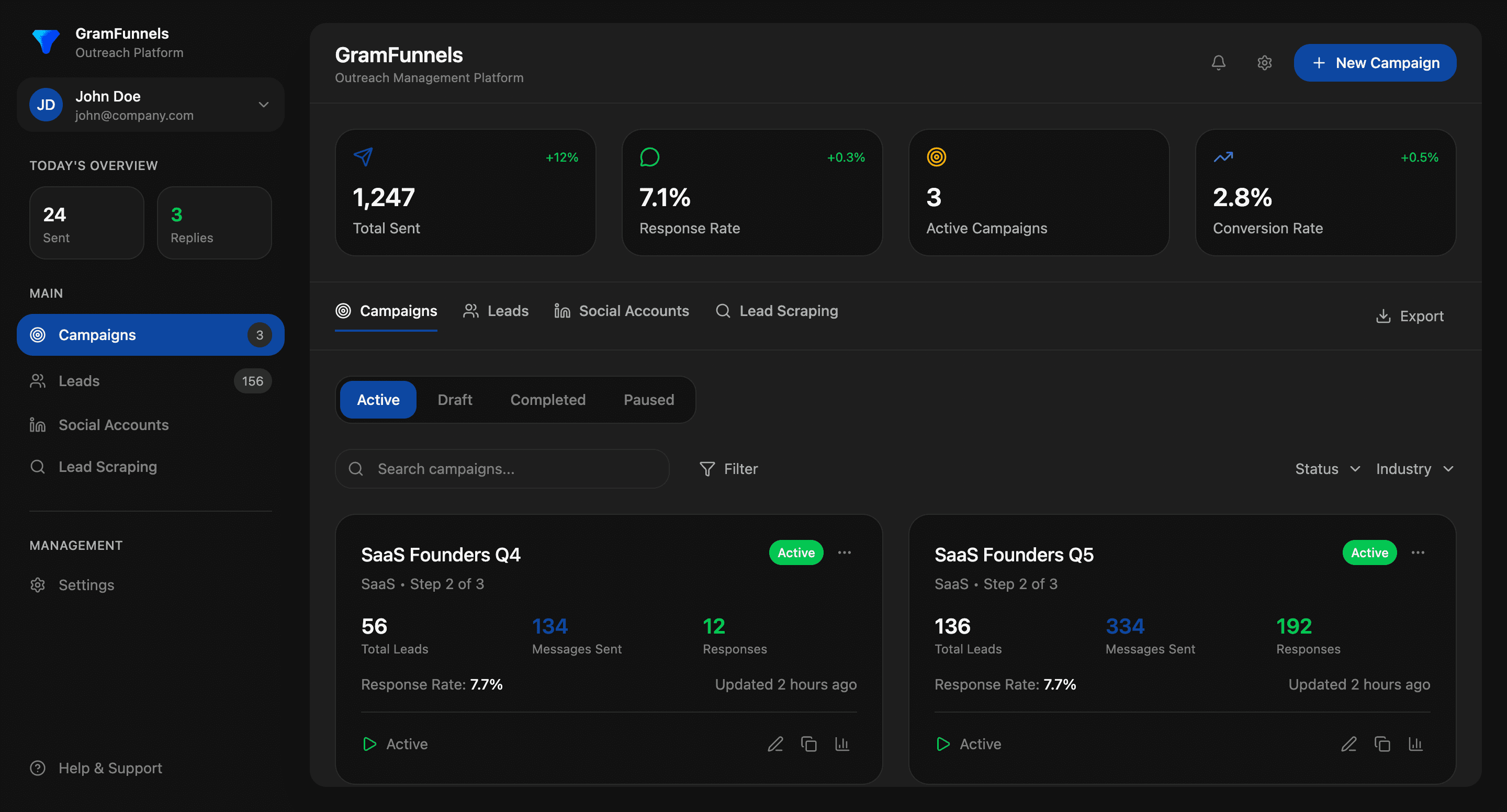
LinkedIn is arguably the most valuable channel for B2B outbound, but manual outreach doesn't scale. The challenge is that aggressive automation risks account restrictions. Solutions like GramFunnels address this by running outreach through external infrastructure rather than your personal account. This allows you to reach prospects at scale while protecting your brand and account standing. The platform's Demand Surface mapping identifies people already engaging with competitors or showing buying intent, so you're reaching prospects at the moment they're most receptive.
Communication Tools
Beyond email, consider tools for other channels:
- Video messaging: Loom or Vidyard for personalized video outreach
- Calling platforms: Aircall or Dialpad for cloud-based calling with local presence
- Direct mail automation: Sendoso or Postal for physical touches to high-value accounts
Analytics and Reporting
Tools like Gong and Chorus record and analyze sales conversations, identifying patterns in successful calls and coaching opportunities. Dashboarding platforms like Tableau or Looker aggregate data from multiple systems for comprehensive performance visibility.
Stack Integration
The power of these tools multiplies when they work together. Prioritize platforms with strong APIs and native integrations. Zapier or Make can bridge gaps between systems. Your goal is a seamless flow of data from prospecting through closed deals without manual data entry.
Choosing Your Stack
Don't try to implement everything at once. Start with core infrastructure (CRM and engagement platform), validate your process, then add specialized tools as specific needs emerge. The best stack is the one your team actually uses consistently, not the one with the most features.
Measuring Success in Outbound Sales
You can't improve what you don't measure. Effective outbound sales requires tracking metrics at each stage of the process, from initial outreach through closed deals.
Activity Metrics
Activity metrics measure effort and volume. While results matter more, consistent activity is the foundation:
- Accounts prospected: New companies added to outreach campaigns
- Emails sent: Total outreach volume across campaigns
- Calls made: Attempted phone conversations with prospects
- LinkedIn connection requests: Outreach attempts on social platforms
- Sequences launched: Prospects entered into multi-touch campaigns
Track these daily or weekly. Drops in activity usually precede drops in pipeline by several weeks.
Engagement Metrics
Engagement metrics show whether your outreach resonates with prospects:
- Email open rate: Should be 40-60% for well-targeted campaigns
- Email reply rate: Aim for 5-15% depending on list quality and messaging
- LinkedIn connection acceptance: 30-50% is typical for relevant prospects
- LinkedIn message response rate: 10-25% for first-degree connections
- Call connection rate: 20-40% of calls reaching the intended person
Low engagement rates signal problems with targeting, messaging, or timing. Test variables systematically to identify what's not working.
Conversion Metrics
Conversion metrics track progression through your sales process:
- Meeting booking rate: Percentage of engaged prospects who schedule discovery calls
- Meeting show rate: Percentage of scheduled meetings that actually occur (should be 70-85%)
- SQL (Sales Qualified Lead) rate: Percentage of meetings that meet qualification criteria
- Opportunity creation rate: SQLs that enter formal sales process
- Win rate: Percentage of opportunities that close as customers
These metrics reveal where prospects drop out of your process. A high meeting booking rate but low SQL rate suggests qualification problems. High SQL rate but low win rate points to issues in the closing process.
Pipeline Metrics
Pipeline metrics connect activity to revenue:
- Pipeline created: Total dollar value of new opportunities from outbound
- Average deal size: Typical contract value for outbound-sourced deals
- Sales cycle length: Time from first contact to closed deal
- Pipeline velocity: Rate at which opportunities progress through stages
- Cost per opportunity: Total outbound spend divided by opportunities created
These metrics help you forecast revenue and calculate ROI on outbound investments.
Quality Metrics
Not all pipeline is created equal. Quality metrics help you focus on the right activities:
- Win rate by source: Which campaigns and channels generate highest-quality pipeline
- Revenue by channel: Actual closed revenue attributed to different outreach methods
- Customer acquisition cost (CAC): Total cost to acquire each customer through outbound
- Lifetime value (LTV): Revenue generated by outbound customers over their lifetime
Your goal is maximizing LTV:CAC ratio, not just activity volume.
Leading vs. Lagging Indicators
Activity and engagement are leading indicators; they predict future results. Pipeline and revenue are lagging indicators; they show what already happened. Track both, but manage the business primarily on leading indicators. If activity drops today, you won't see the pipeline impact for weeks or months.
Benchmarking Your Performance
Context matters when evaluating metrics. A 5% reply rate might be excellent for cold outreach to enterprise CIOs, but poor for warm introductions to small business owners. Benchmark against:
- Your own historical performance to track improvement
- Industry standards for your market and deal size
- Top performers on your team to identify best practices
Most importantly, use metrics to drive action, not just reporting. Every metric should answer a question that informs a decision.
Common Challenges in Outbound Sales and How to Overcome Them
Even with solid strategy and execution, outbound sales presents persistent challenges. Understanding and addressing these obstacles separates successful teams from those that struggle.
Low Response Rates
The Challenge: Average email response rates hover around 1-3% for cold outreach. On LinkedIn, many connection requests go unanswered. This can demoralize teams and make pipeline goals feel unattainable.
The Solution: Focus on relevance over volume. Better targeting based on intent signals dramatically improves response rates. Reference specific triggers like recent company news, content they've engaged with, or shared connections. Test different subject lines, sending times, and message lengths. Most importantly, ensure your initial message provides clear value rather than asking for something.
Data Quality Issues
The Challenge: Bounced emails, wrong phone numbers, and outdated job titles waste time and hurt deliverability. Some estimates suggest 30% of B2B contact data becomes outdated annually as people change roles.
The Solution: Implement a data hygiene process. Use multiple data sources to verify contacts before outreach. Regularly clean your CRM of invalid records. Consider data enrichment tools that append and verify information automatically. When you get bounces or wrong numbers, document them to improve your data providers' accuracy over time.
Deliverability Problems
The Challenge: Emails landing in spam folders never get read. Overly aggressive sending patterns or poor list quality can damage your domain reputation, causing long-term deliverability issues.
The Solution: Warm up new sending domains gradually. Keep sending volumes consistent rather than spiking. Personalize messages to avoid spam trigger words. Implement proper technical setup (SPF, DKIM, DMARC records). Remove hard bounces immediately. Monitor deliverability metrics closely and adjust when you see declines. Some teams use multiple domains to isolate reputation risk.
Sales and Marketing Misalignment
The Challenge: When sales and marketing work in silos, you get conflicting messages, duplicated effort, and poor lead handoff processes. Marketing complains sales doesn't follow up fast enough; sales complains marketing's leads are low quality.
The Solution: Create shared definitions of lead stages, qualification criteria, and target accounts. Hold regular meetings between teams to review results and align on strategy. Implement closed-loop reporting so marketing sees which campaigns drive revenue, not just leads. Consider shared goals and compensation tied to revenue rather than siloed metrics.
Scaling Personalization
The Challenge: Personalized outreach works, but it's time-consuming. Generic templates at scale get ignored. How do you balance efficiency with effectiveness?
The Solution: Create layered personalization. Develop strong persona-based templates as your foundation. Use dynamic fields for basic personalization (name, company, role). Reserve high-touch, fully custom messages for your highest-value accounts. Leverage AI tools to suggest talking points based on recent prospect activity. Document what works so your team can replicate successful approaches without starting from scratch each time.
Long Sales Cycles
The Challenge: Complex B2B sales can take 6-18 months from first contact to close. This makes it difficult to maintain momentum, forecast accurately, and show ROI on outbound investments.
The Solution: Build systematic nurture sequences for prospects not ready to buy now. Provide ongoing value through insights, content, and relevant introductions. Use multi-threading to engage multiple stakeholders and maintain relationships even when your primary contact goes dark. Track pipeline velocity metrics to identify and address bottlenecks. Set expectations with leadership about realistic timelines based on your actual data.
Team Burnout
The Challenge: Outbound sales is demanding. Constant rejection, high activity requirements, and pressure to hit quotas can lead to burnout, especially among SDRs.
The Solution: Set realistic expectations about activity levels and conversion rates. Celebrate small wins, not just closed deals. Provide clear career progression paths so SDRs see a future beyond prospecting. Rotate target accounts or industries periodically to keep things interesting. Invest in training and development so team members feel they're building valuable skills. Most importantly, create a supportive culture where challenges are discussed openly rather than hidden.
Keeping Up with Platform Changes
The Challenge: LinkedIn, email providers, and other platforms constantly update policies and algorithms. What worked six months ago may not work today.
The Solution: Stay informed through industry communities, vendor updates, and testing. Don't rely on single channels or tactics; diversification provides resilience. Work with partners and tools that handle compliance and platform changes so you can focus on strategy and execution rather than technical details.
Case Studies: Successful Outbound Sales Campaigns
Theory matters, but nothing illustrates what works better than real examples. These case studies show how different companies approached outbound challenges and achieved measurable results.
Case Study 1: SaaS Company Enters New Market
Situation: A project management software company wanted to expand from creative agencies into professional services firms. They had no existing relationships in the new market and limited brand recognition.
Approach: Rather than broad outreach, they identified professional services firms that had recently grown rapidly (hiring trigger) or expanded into new offices (expansion trigger). The outreach message focused on specific operational challenges that come with growth, referencing the firm's actual expansion. They used a multi-channel sequence combining personalized emails, LinkedIn messages, and strategic calls.
Results: Over three months, they booked 43 qualified meetings from 600 target accounts (7.2% conversion rate). The highly targeted approach meant 65% of meetings resulted in opportunities. They closed 8 deals in the first six months, establishing credibility in the new market. The key was reaching prospects at a moment when they were experiencing the problem the software solved.
Case Study 2: Consulting Firm Uses Account-Based Approach
Situation: A management consulting firm wanted to land 10 specific Fortune 500 accounts but had no existing relationships with decision-makers at these companies.
Approach: They dedicated one consultant to research each target account for two weeks, identifying strategic initiatives, recent leadership changes, and specific operational challenges. They mapped the buying committee at each account (typically 6-8 people) and created tailored outreach for each stakeholder based on their role. They combined direct outreach with thought leadership content addressing each account's specific challenges.
Results: Within six months, they had engaged conversations with 8 of the 10 target accounts. They closed 3 contracts totaling $2.8M in the first year. While the upfront investment was significant, the win rate on targeted accounts was 4x higher than their typical cold outreach. The case demonstrates that for high-value deals, deep research and coordination pays off.
Case Study 3: E-commerce Platform Leverages Intent Signals
Situation: An e-commerce platform was struggling with low reply rates from generic cold outreach. Their sales cycle was long because prospects weren't actively shopping for new platforms.
Approach: They shifted to intent-based targeting, identifying prospects who showed signals of potential platform issues: complaints about current systems on LinkedIn, job postings for e-commerce managers (suggesting growth), engagement with competitor content, and searches for platform alternatives. Their outreach message referenced the specific signal ("I noticed you recently posted about..." or "Saw you're expanding your team...") and positioned their solution as addressing that specific challenge.
Results: Reply rates jumped from 3% to 18% when referencing genuine intent signals. Sales cycle shortened by 40% because prospects were already thinking about solutions. The pipeline quality improved dramatically; 45% of meetings converted to opportunities versus 20% previously. The lesson: timing matters as much as targeting.
Case Study 4: Agency Builds Predictable Pipeline
Situation: A B2B marketing agency had been relying entirely on referrals and inbound leads. Growth was unpredictable, and they wanted to build a systematic outbound engine.
Approach: They built a tightly defined ICP (B2B SaaS companies, 50-200 employees, recently raised Series A funding) and hired two dedicated SDRs. They tested different messaging angles over six weeks, tracking response and conversion rates for each variation. They settled on a value-first approach that shared specific insights from similar companies rather than pitching services immediately. They implemented a structured cadence with clear activity targets and conversion metrics.
Results: After three months, they achieved predictable outputs: 50-60 qualified conversations per month, leading to 8-10 qualified opportunities, resulting in 2-3 closed deals. This predictability allowed them to forecast revenue confidently and make informed hiring decisions. Within a year, outbound represented 40% of new revenue and had grown from zero to their most reliable acquisition channel. The key was patience in testing, discipline in process, and focus on a narrow ICP.
Conclusion: The Future of Outbound Sales
Outbound sales isn't disappearing; it's evolving. The future belongs to teams that combine the precision of data-driven targeting with genuinely helpful, human-centered outreach.
Several trends are reshaping the outbound landscape:
Intent signals will become the foundation of targeting. As more buyer behavior moves online, the data showing what prospects are researching, who they're engaging with, and what problems they're trying to solve becomes richer. Successful outbound teams will stop interrupting strangers and start joining conversations prospects are already having.
AI will augment, not replace, sales professionals. Technology will handle research, draft personalized messages, identify optimal timing, and surface relevant insights. But the human elements - building trust, understanding nuanced needs, and navigating complex buying processes - remain essential. The most successful reps will use AI to multiply their effectiveness, not replace their judgment.
Multi-channel orchestration will be table stakes. Prospects engage across email, LinkedIn, phone, and in-person channels. Coordinated sequences that maintain consistent messaging while varying channels and touchpoints will outperform single-channel approaches.
Quality will trump quantity. The days of blasting thousands of identical emails and hoping for responses are ending. Email providers and platforms are getting better at filtering low-quality outreach. Success will come from relevant, researched messages to smaller, highly qualified lists.
Privacy regulations will shape tactics. GDPR, CCPA, and future privacy laws will continue restricting how companies can collect and use contact data. Successful teams will adapt by focusing on public information, opt-in relationships, and permission-based marketing.
For businesses serious about outbound sales, the path forward is clear: invest in understanding your ideal customers deeply, leverage technology to identify and reach them at scale, and deliver genuinely valuable interactions at every touchpoint. The companies that master this balance will build predictable, scalable revenue engines while their competitors struggle with declining response rates and rising costs.
Outbound sales done right transforms from interruption to invitation - reaching the right people at the right time with messages that genuinely help them solve problems and achieve goals. That approach isn't just more effective; it's the only sustainable path forward in an increasingly skeptical, informed marketplace.
Whether you're building your first outbound function or optimizing an existing operation, the fundamental principle remains: understand your prospects, reach them where they are, and provide value before asking for anything in return. Master that, and outbound sales becomes your most controllable, predictable path to revenue growth.