ZoomInfo has become synonymous with B2B contact data, but it's far from the only player in the market. With pricing that can reach $15,000-$30,000+ annually and features that many businesses don't fully utilize, it's worth exploring companies like ZoomInfo that might better fit your specific needs and budget.
Whether you're looking for more affordable options, better data accuracy, intent signal capabilities, or specialized features for your industry, this guide covers 11 alternatives that range from direct competitors to complementary tools that solve different aspects of the prospecting challenge.
Why Look for ZoomInfo Alternatives?
Before diving into specific companies like ZoomInfo, let's understand why businesses seek alternatives in the first place. ZoomInfo is an excellent platform, but it's not universally the right fit.
Cost Considerations
ZoomInfo's pricing structure can be prohibitive for small businesses and startups. Annual contracts typically start around $15,000 for basic access and can exceed $30,000 for enterprise features. For companies just starting their outbound motion or those with limited budgets, this represents a significant commitment before proving ROI.
Feature Overload vs. Specific Needs
ZoomInfo offers a comprehensive suite of features including contact data, intent signals, conversation intelligence, and more. However, many businesses only need one or two of these capabilities. Paying for a full platform when you only need contact enrichment or intent data doesn't make financial sense.
Data Coverage and Accuracy
While ZoomInfo boasts extensive coverage, no single database covers every market equally well. Depending on your target geography, industry, or company size, other providers may have superior coverage. Some businesses find that ZoomInfo's data accuracy varies by region or struggles with certain niche industries.
Integration and Workflow Requirements
Different companies like ZoomInfo excel at different aspects of the sales workflow. Some integrate better with specific CRMs, while others offer superior LinkedIn integration or email deliverability features. Your existing tech stack may be better served by a specialized alternative.
Traditional B2B Data Providers (ZoomInfo's Direct Competitors)
These companies compete directly with ZoomInfo's core offering: comprehensive B2B contact databases with firmographic and technographic data.
1. Apollo.io
Apollo.io has emerged as one of the most popular ZoomInfo alternatives, particularly among growing companies. With a database of over 275 million contacts and 73 million companies, Apollo offers comparable coverage at a fraction of the cost.
Key Features:
- Extensive B2B contact database with direct dials and verified emails
- Built-in email sequencing and LinkedIn automation
- Chrome extension for prospecting while browsing
- Buyer intent data and engagement tracking
- CRM integration with Salesforce, HubSpot, and others
Pricing: Apollo offers a generous free tier with 50 email credits per month. Paid plans start at $49/user/month, making it significantly more accessible than ZoomInfo.
Best For: Small to mid-sized B2B companies that want an all-in-one prospecting and outreach platform without enterprise pricing.
2. Cognism
Cognism positions itself as a global sales intelligence platform with particularly strong coverage in Europe and APAC markets. The platform emphasizes data quality and compliance, with a focus on GDPR adherence.
Key Features:
- Phone-verified mobile numbers and compliance-checked data
- Strong international coverage (especially Europe)
- Intent data through Bombora integration
- Technographic and firmographic enrichment
- Diamond Data® for premium verified contacts
Pricing: Custom pricing based on seats and features, typically ranging from $6,000-$20,000 annually.
Best For: Companies targeting European or international markets where GDPR compliance is critical and data quality matters more than database size.
3. Lusha
Lusha started as a simple Chrome extension for finding contact information and has evolved into a comprehensive prospecting platform. It remains one of the easiest-to-use options among companies like ZoomInfo.
Key Features:
- Simple, intuitive interface with minimal learning curve
- Chrome extension for instant contact enrichment
- Direct dial phone numbers and email addresses
- CRM enrichment and data cleansing
- Job change alerts for relationship monitoring
Pricing: Free plan with 5 credits monthly. Pro plans start at $29/user/month for 80 credits, with scale plans offering unlimited credits starting around $51/user/month.
Best For: Individual sales reps and small teams that prioritize ease of use and quick implementation over advanced features.
4. Clearbit
Clearbit takes a different approach than traditional contact databases. Rather than providing a searchable database, it focuses on real-time data enrichment and API-first architecture for technical teams.
Key Features:
- Real-time company and contact enrichment via API
- Website visitor identification (Reveal)
- Form shortening and progressive profiling
- Data normalization and standardization
- Advanced filtering and segmentation
Pricing: Custom pricing based on API calls and features, typically starting around $1,000/month for enrichment packages.
Best For: Product-led growth companies and technical teams that want to build data enrichment directly into their product or marketing automation workflows.
Specialized Intent Data and Signal Intelligence Platforms
These companies focus specifically on identifying companies showing active buying intent rather than providing comprehensive contact databases. They're particularly valuable for prioritizing outreach efforts.
5. Bombora
Bombora pioneered the concept of "Intent Data" by tracking content consumption across a cooperative of B2B websites. Their Company Surge® data identifies accounts actively researching specific topics.
Key Features:
- Company Surge® intent data tracking content consumption
- Topic-based intent signals across 10,000+ categories
- Data cooperative model with 4,000+ B2B sites
- Integration with major ABM and marketing platforms
- Custom intent topics for specialized markets
Pricing: Custom pricing based on topic categories and volume, typically $20,000+ annually.
Best For: Enterprise B2B companies running account-based marketing programs that need to prioritize outreach based on active research behavior.
For more on how to leverage buyer intent data effectively, see our guide on buyer intent software.
6. 6sense
6sense combines intent data with predictive analytics and account-based orchestration. It's positioned as an end-to-end revenue platform rather than just a data provider.
Key Features:
- AI-driven predictive analytics for account scoring
- Multi-source intent data aggregation
- Anonymous visitor identification
- Account-based advertising orchestration
- Pipeline intelligence and forecasting
Pricing: Enterprise pricing starting around $30,000 annually, varying significantly based on features and company size.
Best For: Large enterprises with complex sales cycles that need comprehensive account-based experience platforms combining intent, advertising, and analytics.
LinkedIn-Focused Prospecting Tools
Since LinkedIn is where most B2B prospecting happens, several specialized tools focus exclusively on maximizing LinkedIn's potential for finding and engaging prospects.
7. LinkedIn Sales Navigator
Sales Navigator is LinkedIn's native premium tool for prospecting. While it doesn't provide direct contact information, it offers unmatched access to LinkedIn's first-party data.
Key Features:
- Advanced search with 40+ filters
- Lead recommendations based on your preferences
- InMail messaging credits for reaching non-connections
- Real-time alerts for job changes and company updates
- CRM integration and lead list management
Pricing: $99.99/month for Professional, $149.99/month for Team, with custom enterprise pricing.
Best For: Sales professionals who do significant prospecting on LinkedIn and want native platform capabilities without third-party tools.
For alternatives to Sales Navigator, check out our comparison of Sales Navigator alternatives for lead generation.
8. PhantomBuster
PhantomBuster automates LinkedIn prospecting through "Phantoms" - pre-built automation workflows that extract data and engage with prospects.
Key Features:
- 100+ pre-built automation workflows
- LinkedIn profile and Sales Navigator scraping
- Automated connection requests and messaging
- Email finding from LinkedIn profiles
- Multi-platform automation (LinkedIn, Twitter, Instagram)
Pricing: Plans start at $59/month for basic automation, with professional plans at $159/month.
Best For: Technical users comfortable with automation who want to build custom prospecting workflows beyond standard tool limitations.
Learn more about LinkedIn automation in our guide to LinkedIn automation tools.
Intent-Based Outbound Platforms
Rather than focusing on static contact data, these platforms identify prospects showing real-time buying signals and help you reach them at the right moment.
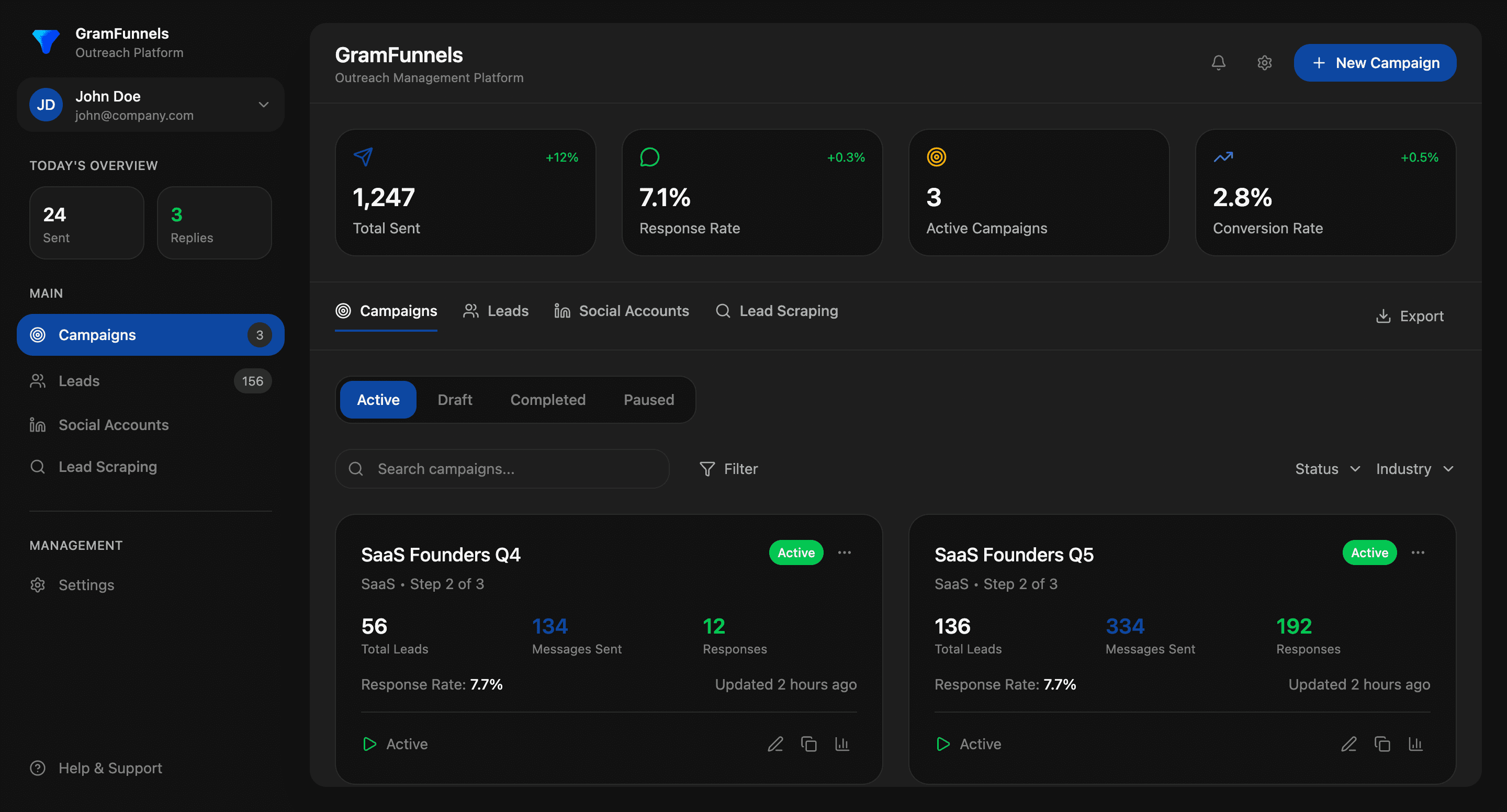
9. GramFunnels
GramFunnels takes a different approach than traditional companies like ZoomInfo by focusing exclusively on high-intent prospecting on LinkedIn. Rather than providing a database of contacts, it identifies prospects actively showing buying behavior in real-time.
Key Features:
- Demand Surface Mapping to identify 300+ intent signals on LinkedIn
- AI SDR that automates prospecting and personalized outreach 24/7
- External infrastructure to protect personal LinkedIn accounts and domain reputation
- Unified inbox for managing conversations across multiple accounts
- AI-personalized messaging based on prospect activity and behavior
Pricing: Starts at $99/month for self-service, with a Done-For-You option at $500/month that includes managed outreach and guaranteed meetings.
Best For: B2B companies focused on LinkedIn outbound who want to reach prospects already showing buying intent rather than cold contacting static lists.
To understand more about finding prospects with active buying intent, read our guide on high-intent leads and identifying high-intent buyer signals.
10. Seamless.AI
Seamless.AI uses artificial intelligence to find and verify contact information in real-time rather than relying on a pre-existing database.
Key Features:
- Real-time contact search and verification
- AI-powered data enrichment
- Chrome extension for instant prospecting
- Writer tool for AI-generated email copy
- Integration with major CRMs and sales tools
Pricing: Free plan with limited credits, paid plans start at $147/month for individuals.
Best For: Sales professionals who want accurate, real-time data and don't mind a per-search model over unlimited database access.
Niche and Industry-Specific Alternatives
11. UpLead
UpLead positions itself as a more affordable, accuracy-focused alternative to enterprise platforms. They emphasize data quality over quantity with a 95% data accuracy guarantee.
Key Features:
- Database of 108M+ B2B contacts with 95% accuracy guarantee
- Real-time email verification before download
- Technographic data for 16,000+ technologies
- Intent data to identify in-market accounts
- Chrome extension and API access
Pricing: Plans start at $99/month for 170 credits, with professional plans at $199/month for 400 credits.
Best For: Growing businesses that prioritize data accuracy and want a middle ground between free tools and enterprise platforms.
How to Choose Among Companies Like ZoomInfo
With so many options available, selecting the right platform requires evaluating your specific needs, budget, and workflow.
Define Your Primary Use Case
Start by identifying what you actually need: Is it contact data? Intent signals? LinkedIn automation? Enrichment for existing leads? Different tools excel at different jobs. ZoomInfo tries to be comprehensive, but specialized tools often perform better for specific use cases.
Evaluate Data Coverage for Your Market
Not all databases cover all markets equally. If you target European companies, APAC tech startups, or niche industries, test the coverage in your specific segment before committing. Request a trial or demo focused on your actual target accounts to verify coverage and accuracy.
Consider Integration Requirements
How will this tool fit into your existing workflow? Does it integrate with your CRM, marketing automation, and sales engagement platforms? Native integrations save time and reduce data silos. API access matters if you want to build custom workflows.
Calculate True Cost Beyond Subscription Price
Look beyond the monthly or annual subscription fee. Consider:
- Implementation time and technical resources required
- Training time for your team to become proficient
- Additional costs for add-ons, premium data, or API calls
- Opportunity cost of choosing a tool that doesn't fit your workflow
Test Data Accuracy in Your Market
Data accuracy varies significantly between providers and markets. Before committing, export a sample of contacts in your target segment and verify accuracy manually. Check bounce rates on emails and connection rates on phone numbers. A smaller database with higher accuracy often delivers better results than a massive database with outdated information.
Match Tool Sophistication to Team Capability
Enterprise platforms offer powerful features but require expertise to leverage fully. If you have a small team without dedicated sales operations resources, a simpler tool with an intuitive interface might deliver better results than a feature-rich platform that goes underutilized.
Combining Multiple Tools for Maximum Effect
Rather than trying to find a single ZoomInfo replacement, many successful teams combine specialized tools that excel at different aspects of prospecting.
The Intent + Outreach Stack
Combine an intent data platform (like Bombora or GramFunnels) with a contact database (like Apollo or Lusha). Use intent data to identify companies actively researching solutions, then use contact data to find and reach decision-makers at those companies. This approach focuses outreach on high-probability accounts rather than spray-and-pray cold outreach.
The LinkedIn-First Stack
For teams focused on LinkedIn outbound, combine Sales Navigator for research with automation tools for scale and enrichment tools for contact data. This approach maximizes LinkedIn's native capabilities while filling gaps in direct contact information and automation. Learn more about LinkedIn high-intent targeting.
The Enrichment + Automation Stack
Use a lightweight enrichment tool (like Clearbit) to enhance data you already have, combined with an AI SDR platform to automate outreach. This works well for companies with existing lead sources (content marketing, events, partnerships) who need to enrich and engage those leads at scale. Discover more about AI SDR tools and explore the best AI SDR platforms.
The Future of B2B Data and Prospecting
The market for B2B data and prospecting tools continues to evolve rapidly. Several trends are reshaping how companies approach outbound:
From Static Data to Real-Time Signals
Traditional contact databases provide snapshots that become outdated quickly. The industry is shifting toward real-time signals that identify prospects at moments of active buying intent. This change fundamentally alters the prospecting approach from "who can I contact?" to "who should I contact right now?"
AI-Powered Personalization at Scale
Generic cold outreach is increasingly ineffective. AI tools now analyze prospect activity, company news, and engagement history to generate truly personalized messaging at scale. This isn't mail merge - it's intelligent analysis of each prospect's context to craft relevant, timely outreach. For more on how AI is transforming sales development, see our guide on modern outbound sales strategies.
Privacy Regulations and Data Quality
GDPR, CCPA, and emerging privacy regulations are forcing data providers to prioritize compliance and transparency. The days of scraping any available information are ending. Legitimate providers are investing in verified, consented data sources and clear audit trails.
Integration and Workflow Automation
Best-of-breed tools are becoming more interoperable through APIs and native integrations. Rather than forcing teams into all-in-one platforms, the trend is toward flexible stacks where specialized tools work together seamlessly.
Key Takeaways
When evaluating companies like ZoomInfo, remember these essential points:
- No single platform is universally superior - the right choice depends on your specific market, budget, team size, and use case
- Data accuracy matters more than database size - a smaller database with verified, current information outperforms a massive database with outdated contacts
- Intent signals improve conversion rates - reaching prospects showing active buying behavior dramatically increases response and conversion rates compared to cold outreach
- Specialized tools often outperform generalists - a tool built specifically for LinkedIn prospecting or intent detection may deliver better results than a platform trying to do everything
- Test before committing - request trials and demos using your actual target accounts to verify coverage, accuracy, and workflow fit
- Consider tool combinations - combining specialized tools for intent, contact data, and outreach often works better than a single expensive platform
ZoomInfo established the category of comprehensive B2B intelligence platforms, but the market has matured significantly. Whether you need a more affordable option, better coverage in your specific market, specialized intent capabilities, or a different approach to prospecting entirely, alternatives exist that may better serve your needs.
The key is understanding what you actually need from a prospecting tool, testing options in your specific market, and choosing based on results rather than brand recognition or feature checklists. The best companies like ZoomInfo are the ones that fit your workflow, deliver accurate data for your market, and provide clear ROI for your specific use case.