The sales development landscape has fundamentally changed. Traditional SDR teams are expensive, difficult to scale, and often struggle with consistency. AI SDR tools promise to solve these challenges by automating prospecting, outreach, and follow-up while maintaining personalization at scale.
But with dozens of platforms claiming to be the "best AI SDR," how do you actually choose? This guide breaks down what AI SDR tools actually do, evaluates the top platforms across different use cases, and helps you make an informed decision based on your specific needs.
What Are AI SDR Tools and How Do They Work?
AI SDR tools are software platforms that automate the core functions of a Sales Development Representative. Rather than manually researching prospects, writing personalized emails, and tracking follow-ups, these tools use artificial intelligence to handle the entire process.
Here's what the best AI SDR tools typically include:
- Automated Prospecting: AI identifies and qualifies potential customers based on your ideal customer profile (ICP)
- Intent Data Integration: Platforms track buying signals like competitor engagement, content consumption, and job changes
- Personalized Outreach: Natural language models generate contextual messages based on prospect behavior and company data
- Multi-Channel Sequences: Automated follow-up across email, LinkedIn, and sometimes phone
- Response Handling: AI can categorize responses, identify qualified leads, and even engage in basic back-and-forth conversations
- CRM Integration: Automatic syncing of activities, leads, and opportunities to your existing sales stack
The sophistication varies dramatically. Some tools are glorified email automation with basic personalization tokens. Others use advanced language models to actually understand context, identify high-intent buyer signals, and adapt messaging based on prospect responses.
Key Features to Evaluate in AI SDR Platforms
Not all AI SDR tools are created equal. When comparing platforms, focus on these critical capabilities:
1. Intent Signal Detection
The best tools don't just send cold outreach to lists. They identify prospects who are already showing buying behavior. This includes:
- Engagement with competitor content on LinkedIn
- Job postings indicating tool adoption or team growth
- Website visits and content downloads
- Technology stack changes
- Funding announcements and expansion signals
Platforms with robust intent data dramatically improve response rates because you're reaching people who actually need your solution right now, not in six months.
2. Personalization Depth
Basic personalization ("Hi {{FirstName}}, I noticed {{Company}} is hiring") doesn't work anymore. Look for tools that:
- Reference specific prospect activities and behaviors
- Adapt messaging based on industry, company size, and role
- Learn from response patterns to improve over time
- Generate truly unique messages, not templated variations
3. Deliverability Infrastructure
Many AI SDR tools fail because they destroy sender reputation. The best platforms:
- Use dedicated domains separate from your corporate email
- Warm up sender accounts gradually
- Monitor bounce rates and engagement metrics
- Rotate sending infrastructure to maintain high deliverability
If a tool sends from your primary domain and tanks your email reputation, the AI capabilities are irrelevant because your messages won't reach inboxes.
4. Conversation Intelligence
Response handling separates basic automation from true AI SDRs. Advanced platforms can:
- Identify positive, negative, and neutral responses
- Detect objections and address them contextually
- Book meetings directly when prospects express interest
- Escalate qualified conversations to human reps at the right moment
5. Channel Coverage
Email-only outreach has declining effectiveness. Multi-channel AI SDRs that combine email with LinkedIn outreach see significantly higher response rates. Some platforms also integrate calling, SMS, and even Twitter outreach, though effectiveness varies by channel and audience.
Top AI SDR Tools: Platform Comparison
Let's examine the leading platforms across different use cases and business needs.
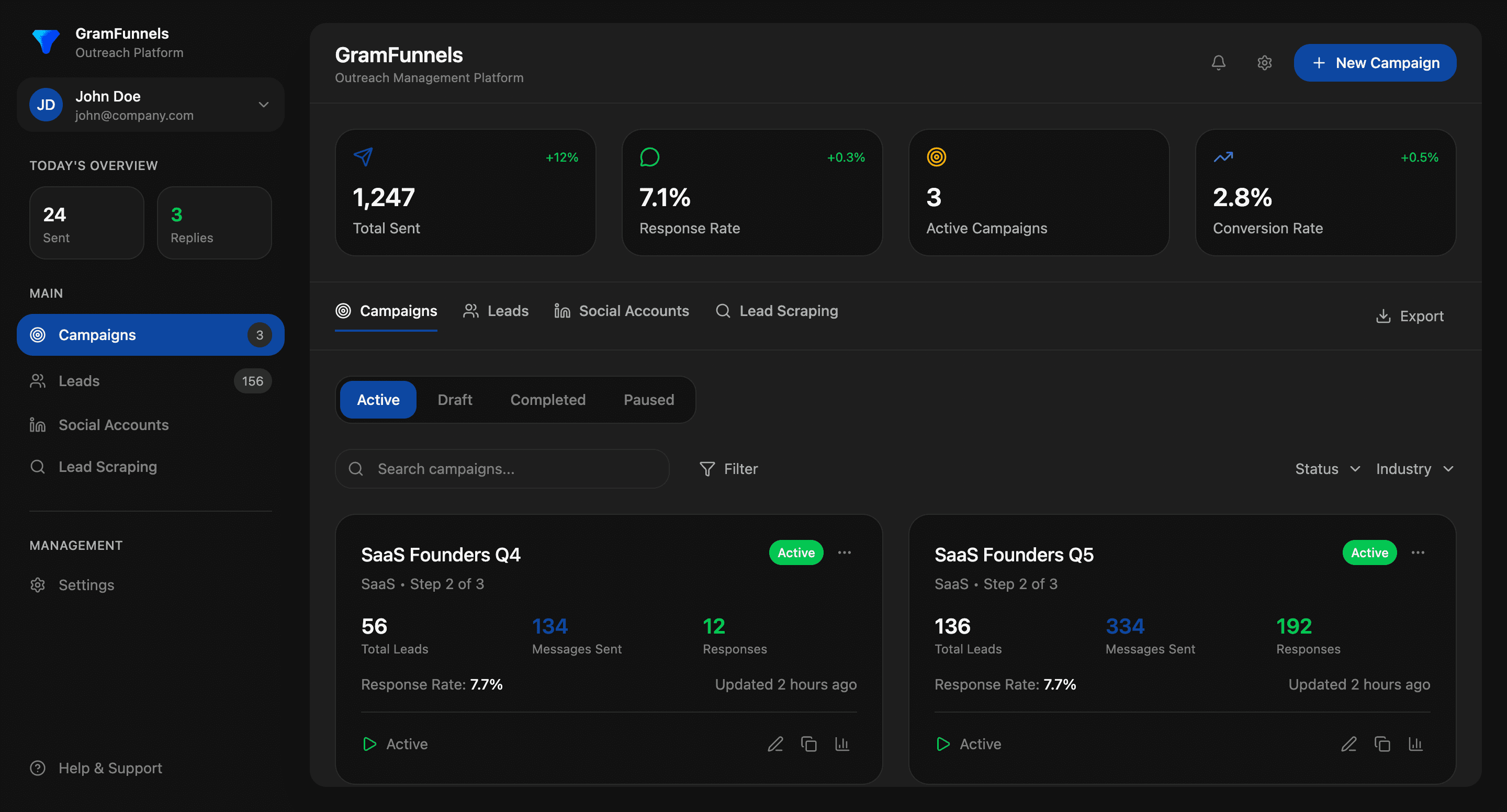
For LinkedIn-Focused Outbound: GramFunnels
If your outbound motion centers on LinkedIn, GramFunnels takes a fundamentally different approach than most AI SDR tools. Rather than blasting cold messages to broad lists, it uses "Demand Surface Mapping" to identify prospects already showing active buying intent on LinkedIn.
The platform monitors 300+ intent signals including competitor engagement, solution searches, and industry discussions. This means you're reaching people at the exact moment they're evaluating solutions, dramatically improving conversion rates.
Key advantages include:
- External infrastructure that protects your personal LinkedIn account and domain reputation
- AI personalization based on real prospect behavior, not generic company data
- 24/7 automated outreach and follow-up with natural conversation handling
- Unified inbox managing conversations across multiple accounts
GramFunnels works exclusively on LinkedIn, which is both a strength (deep platform specialization) and limitation (no email or other channels). For B2B companies where decision-makers are active on LinkedIn, it's particularly effective.
Learn more about LinkedIn high-intent targeting strategies to understand how intent-based prospecting differs from traditional cold outreach.
For Email-First Sequences: Reply.io and Smartlead
Reply.io offers robust email automation with AI-powered personalization. The platform excels at multi-touch sequences, A/B testing, and deliverability management. Their AI SDR feature, Jason AI, can research prospects, write personalized emails, and handle basic objections.
Strengths include:
- Excellent email deliverability tools and sender reputation management
- Strong CRM integrations (Salesforce, HubSpot, Pipedrive)
- Multi-channel capabilities including email, LinkedIn, calls, and SMS
- Detailed analytics and performance reporting
Smartlead.ai focuses specifically on cold email at scale. It's built for agencies and teams running high-volume campaigns across multiple domains. The unlimited sender accounts feature allows you to maintain deliverability even at high volumes.
For Conversation Intelligence: 11x.ai
11x.ai (formerly Tersra) positions their AI SDR, Alice, as a true autonomous agent that handles the full sales development cycle. The platform uses advanced language models to engage in multi-turn conversations, qualify leads, and book meetings.
What sets 11x apart:
- Sophisticated natural language understanding for complex B2B conversations
- Ability to handle objections and answer technical questions
- Integration with voice channels for phone-based prospecting
- Strong enterprise security and compliance features
The platform works best for companies with longer sales cycles where prospects need education and nurturing before they're ready to talk to human reps.
For Data-Rich Prospecting: Clay and Instantly
Clay isn't technically an AI SDR tool, but it's become essential infrastructure for many sales teams. It aggregates data from 50+ sources, uses AI to enrich prospect information, and enables highly personalized outreach at scale.
Teams typically combine Clay with execution platforms like Instantly.ai, which handles the actual sending with strong deliverability features. This "data layer + execution layer" approach gives maximum control and customization.
Best for:
- Teams that want to build custom prospecting workflows
- Companies with unique data requirements or niche ICPs
- Sales operations professionals who can invest time in setup and optimization
For Full-Cycle Sales Automation: Salesforge and Artisan
Salesforge combines email infrastructure, AI writing, and deliverability management in one platform. Their Warmup feature automatically improves sender reputation before campaigns launch.
Artisan.co offers multiple AI workers (SDRs, researchers, copywriters) that work together as a virtual sales team. It's positioned as an end-to-end solution that replaces traditional SDR hiring.
Both platforms target mid-market and enterprise companies looking to replace or augment human SDR teams entirely, rather than just adding automation to existing processes.
Choosing the Right AI SDR Tool for Your Business
The "best" AI SDR tool depends entirely on your specific situation. Here's how to decide:
If You're a B2B Startup or Small Team
Priority: Fast time-to-value, simplicity, cost-effectiveness
Look for tools with:
- Quick setup (days, not weeks)
- Built-in prospect databases so you don't need separate data providers
- Transparent pricing that scales with usage
- Strong deliverability to protect your domain reputation
Consider platforms like Smartlead (email-focused) or GramFunnels (LinkedIn-focused) that provide infrastructure and execution together.
If You're Scaling an Existing SDR Team
Priority: Productivity multiplier, consistency, CRM integration
You want tools that:
- Augment human SDRs rather than replacing them
- Provide deep analytics to identify what's working
- Integrate seamlessly with your existing tech stack
- Allow customization of messaging and workflows
Reply.io or 11x.ai work well here, as they can handle routine prospecting while humans focus on high-value conversations.
If You Run an Agency or Do Client Outreach
Priority: White-label capabilities, multi-account management, deliverability at scale
Essential features:
- Unlimited or high-volume sender accounts
- Client segregation and reporting
- Infrastructure that protects client domains
- Flexible pricing that supports agency business models
Smartlead and Instantly are popular among agencies. GramFunnels' Done-For-You service can also work well if you offer LinkedIn prospecting to clients.
If You're Targeting High-Intent Prospects Only
Priority: Quality over quantity, intent signal detection, timing
This approach focuses on reaching prospects at the exact moment they show buying behavior. Rather than building large lists and hoping for responses, you identify smaller segments of people actively evaluating solutions.
Platforms like GramFunnels specialize in this with Demand Surface Mapping. You can also build custom intent signals using Clay + Phantom Buster + various intent data providers, though this requires more technical setup.
Understanding outbound sales strategies helps you determine whether high-intent targeting or high-volume prospecting makes more sense for your market.
Implementation Best Practices for AI SDR Tools
Even the best AI SDR tool will fail without proper implementation. Here's how to set yourself up for success:
Start With a Single, Narrow Use Case
Don't try to automate your entire outbound motion on day one. Pick one specific segment:
- Companies in a particular industry showing specific intent signals
- Prospects in a certain role at companies of a specific size
- People who engaged with your content but haven't converted
Run a focused test, measure results, and expand only after proving the approach works.
Invest in Your ICP Definition
AI SDR tools are only as good as the targets you feed them. Spend time defining:
- Exact job titles and seniority levels
- Company characteristics (size, funding stage, tech stack)
- Behavioral signals that indicate fit and timing
- Disqualifying factors that should exclude prospects
The tighter your ICP, the better the AI can personalize and the higher your response rates will be.
Write Core Messaging Frameworks, Don't Just Rely on AI
AI generates better messages when you give it structure. Create:
- Value propositions for different personas and industries
- Core pain points your product solves
- Case studies and proof points the AI can reference
- Your company's tone and voice guidelines
The AI should work within your framework, not create messaging from scratch.
Monitor and Optimize Continuously
AI SDRs improve over time, but only if you actively manage them:
- Review message quality weekly, especially early on
- Analyze response patterns to identify what resonates
- A/B test different approaches to the same segment
- Update exclusion lists to avoid burning prospects
- Track deliverability metrics obsessively
Set up a weekly review cadence where you examine performance, make adjustments, and course-correct before problems compound.
Don't Abandon Human Touch Entirely
The most successful teams use AI SDRs for initial outreach and qualification, then transition high-potential conversations to human reps. This hybrid approach gives you:
- Scale and consistency from automation
- Relationship building and complex deal navigation from humans
- Cost efficiency (AI handles volume, humans handle value)
Define clear handoff criteria so prospects get human attention at the right moment in their buying journey.
Common Pitfalls to Avoid With AI SDR Tools
Most AI SDR implementations fail for predictable reasons. Avoid these mistakes:
Over-Automating Too Quickly
It's tempting to turn on AI outreach to your entire database immediately. This usually results in:
- Generic messaging that doesn't resonate
- Burned prospects who won't engage in the future
- Deliverability issues from sudden volume spikes
- No clear data on what's working because everything is tested at once
Start small, validate the approach, then scale gradually.
Ignoring Deliverability Fundamentals
If your emails land in spam, it doesn't matter how good the AI is. Maintain deliverability by:
- Using dedicated domains for outbound, not your primary company domain
- Warming up sender accounts before launching campaigns
- Keeping daily send volumes reasonable (30-50 per account max)
- Monitoring bounce rates, spam complaints, and engagement
Many companies destroy their email reputation with AI SDR tools because they prioritize volume over deliverability.
Not Providing Enough Context to the AI
AI SDRs personalize based on the data you provide. If you only give basic firmographics (company name, industry, employee count), the messages will be generic.
Feed the AI rich context:
- Recent company news, funding announcements, expansions
- Technologies they use that relate to your solution
- Content they've engaged with on LinkedIn or your website
- Mutual connections or relevant case studies
The more specific information the AI has, the more genuine the personalization will be.
Expecting Immediate Results
AI SDR tools typically need 2-4 weeks to show meaningful results. This includes:
- Account warmup and deliverability establishment
- AI learning from initial responses to improve messaging
- Multiple touches in the sequence before prospects respond
- Time for conversations to progress to booked meetings
Evaluate performance over 30-60 days, not week by week.
The Future of AI SDR Tools
The AI SDR category is evolving rapidly. Here's what's coming:
Deeper Intent Signal Integration
Next-generation tools will combine first-party data (website behavior, content engagement), third-party intent data (G2 research, review site activity), and social signals (LinkedIn engagement, job changes) into unified prospect scores.
This means reaching prospects at the exact moment they're evaluating solutions, not months before or after the buying window. Identifying high-intent buyer signals is becoming the primary competitive advantage in outbound sales.
Voice and Video Capabilities
AI SDRs are expanding beyond text-based channels. We're seeing:
- AI-powered voice calls that sound increasingly natural
- Personalized video messages generated at scale
- Voicemail drops with custom messages
- Multi-modal outreach that combines text, voice, and video
These additions will increase response rates but also raise the bar for what "personalized" means.
Tighter Integration With Sales Workflows
AI SDRs will become embedded in the full sales stack:
- Automatic handoffs when prospects hit qualification criteria
- AI-generated briefings for human reps before calls
- Deal intelligence that surfaces insights from past conversations
- Predictive scoring that identifies which leads to prioritize
The line between "SDR tool" and "sales intelligence platform" is blurring.
Vertical-Specific Solutions
We'll see more AI SDR tools built for specific industries (healthcare, financial services, real estate) with pre-trained models that understand industry terminology, compliance requirements, and buying patterns.
Generic tools will still exist, but specialized solutions will win in complex, regulated verticals where context and expertise matter.
Final Recommendations: Which AI SDR Tool Should You Choose?
Here's the bottom line after evaluating dozens of platforms:
For LinkedIn-focused B2B outbound: GramFunnels offers the most sophisticated intent signal detection and personalization on the platform where your buyers actually are. The external infrastructure protects your reputation while the AI handles 24/7 prospecting.
For email-first campaigns: Smartlead.ai (if you need volume and multiple sender accounts) or Reply.io (if you want multi-channel capabilities and strong integrations).
For conversation intelligence: 11x.ai if you need an AI that can handle complex back-and-forth dialogues and objection handling.
For custom prospecting workflows: Clay + Instantly gives maximum flexibility if you have the technical resources to build and maintain custom systems.
For agencies: Smartlead or GramFunnels' Done-For-You service, depending on whether you focus on email or LinkedIn for clients.
Remember: the best AI SDR tool is the one you'll actually use consistently, with proper setup and ongoing optimization. A simpler platform that you fully implement will always outperform a sophisticated one that sits unused because it's too complex.
The era of "spray and pray" cold outreach is over. AI SDR tools that combine intent signal detection, genuine personalization, and multi-channel reach are the future. Choose wisely, implement deliberately, and measure ruthlessly.
For more insights on modern outbound strategies, explore alternatives to traditional prospecting tools and how they fit into a comprehensive sales development strategy.