In B2B sales and marketing, timing is everything. The difference between closing a deal and losing to a competitor often comes down to reaching prospects at the exact moment they're actively researching solutions. This is where B2B intent data providers have fundamentally changed the game.
Intent data reveals which companies and decision-makers are showing buying signals right now-not who might be interested someday, but who is actively evaluating solutions in your category today. For sales and marketing teams drowning in leads that go nowhere, intent data providers offer a way to focus resources on prospects with genuine, measurable buying interest.
This guide breaks down everything you need to know about B2B intent data providers: what they actually do, how they collect and analyze signals, the major players in the market, and most importantly, how to choose the right provider for your specific business needs.
What Are B2B Intent Data Providers?
B2B intent data providers are companies that collect, analyze, and deliver information about organizations showing active buying behavior. Unlike traditional lead databases that simply provide contact information, intent data providers track behavioral signals that indicate when a company is in-market for specific solutions.
These providers monitor hundreds or thousands of digital touchpoints to identify patterns suggesting purchase intent. When multiple decision-makers at a company start researching "marketing automation platforms" or "cloud security solutions," that represents a buying signal worth acting on immediately.
The core value proposition is simple: help sales and marketing teams identify opportunities before competitors do, and reach prospects when they're most receptive to conversations.
How Intent Data Providers Collect Signals
Intent data providers use several methodologies to capture buying signals:
- First-Party Intent Data: Behavioral data collected directly from your own digital properties-website visits, content downloads, email engagement, product page views, and demo requests. This is the highest-quality intent data because it represents people directly engaging with your brand.
- Second-Party Intent Data: Partnerships where companies share their first-party data with each other. For example, a content syndication network might share engagement data showing which companies downloaded whitepapers related to your solution category.
- Third-Party Intent Data: Aggregated behavioral data collected from publisher networks, review sites, industry forums, and other external sources. Providers monitor thousands of B2B websites to track what companies and individuals are researching.
- Social Intent Signals: Activity on professional networks like LinkedIn-who's engaging with competitor content, joining relevant groups, following industry influencers, or posting about specific business challenges.
The most sophisticated providers combine multiple signal sources to create a comprehensive view of buying behavior. A company researching your product category on multiple websites, while decision-makers engage with relevant LinkedIn content, represents much stronger intent than a single isolated signal.
Why B2B Companies Use Intent Data Providers
The adoption of intent data providers has accelerated dramatically as B2B buying behavior has shifted online. According to Gartner, 83% of B2B buyers prefer ordering or paying through digital channels, and buyers complete an average of 57% of their purchase decision before ever contacting a vendor.
This fundamental shift creates a problem: traditional outbound approaches contact prospects too early (when they're not interested) or too late (when they've already chosen a competitor). Intent data providers solve this timing problem.
Key Business Benefits
Improved Lead Qualification: Instead of scoring leads based on static firmographic data, intent signals reveal which accounts are actively in-market. A CTO at a Fortune 500 company might look impressive on paper, but if their company isn't researching solutions in your category, they're not a real opportunity right now.
Higher Conversion Rates: When you reach prospects who are already researching solutions, conversion rates increase dramatically. Studies show that intent-driven campaigns can achieve 3-5x higher conversion rates compared to traditional cold outreach.
Shorter Sales Cycles: Prospects showing intent are further along in their buying journey. They understand their problem, they're evaluating solutions, and they're closer to making a decision. This means fewer educational calls and faster progression through your sales pipeline.
More Efficient Resource Allocation: Sales teams can focus time on accounts with genuine buying interest rather than chasing cold prospects. Marketing can tailor campaigns to address the specific topics and concerns that prospects are actively researching.
Competitive Intelligence: Many intent data providers can show when prospects are researching your competitors. This creates opportunities to intercept deals before competitors establish relationships, or to defend existing accounts showing interest in alternative solutions.
Types of B2B Intent Data Providers
The intent data market has evolved into several distinct categories, each with different approaches and use cases.
Publisher Network Providers
These providers aggregate behavioral data from large networks of B2B publishers, media sites, and content platforms. When companies visit these sites and consume content related to specific topics, the provider captures those signals and makes them available to relevant vendors.
Publisher network providers typically offer broad coverage across many industries and topics. They excel at early-stage intent detection, showing which companies are beginning to research categories before they narrow down to specific vendors.
The tradeoff is that signals can be less precise than other methodologies. A company reading general content about "cybersecurity trends" might not be in active buying mode-they could just be staying informed about their industry.
Bidstream and Ad Tech Providers
Some providers leverage advertising technology and bidstream data to identify intent. When companies click on ads or visit websites as part of ad campaigns, those interactions create signals about research behavior and interests.
This approach offers massive scale-potentially billions of monthly data points across the entire internet. However, the quality varies significantly, and privacy regulations have made this methodology more complex to execute compliantly.
Review and Comparison Site Providers
Platforms like G2, Capterra, and TrustRadius have unique first-party intent data: they know exactly which companies are comparing solutions in specific categories. When someone from Acme Corp compares three CRM platforms on G2, that's an extremely high-intent signal.
This data is incredibly valuable but limited to companies with strong presence on review platforms. If prospects don't use these sites for research, or if your solution isn't well-represented there, the coverage will be limited.
Social and Professional Network Providers
LinkedIn and similar platforms host enormous amounts of professional behavior data. Who follows which company pages, engages with what content, joins which groups, and discusses what topics-all represent potential intent signals.
The challenge is accessing this data compliantly and at scale. LinkedIn's API has strict limitations, and many social intent approaches require indirect signal interpretation rather than explicit purchase intent.
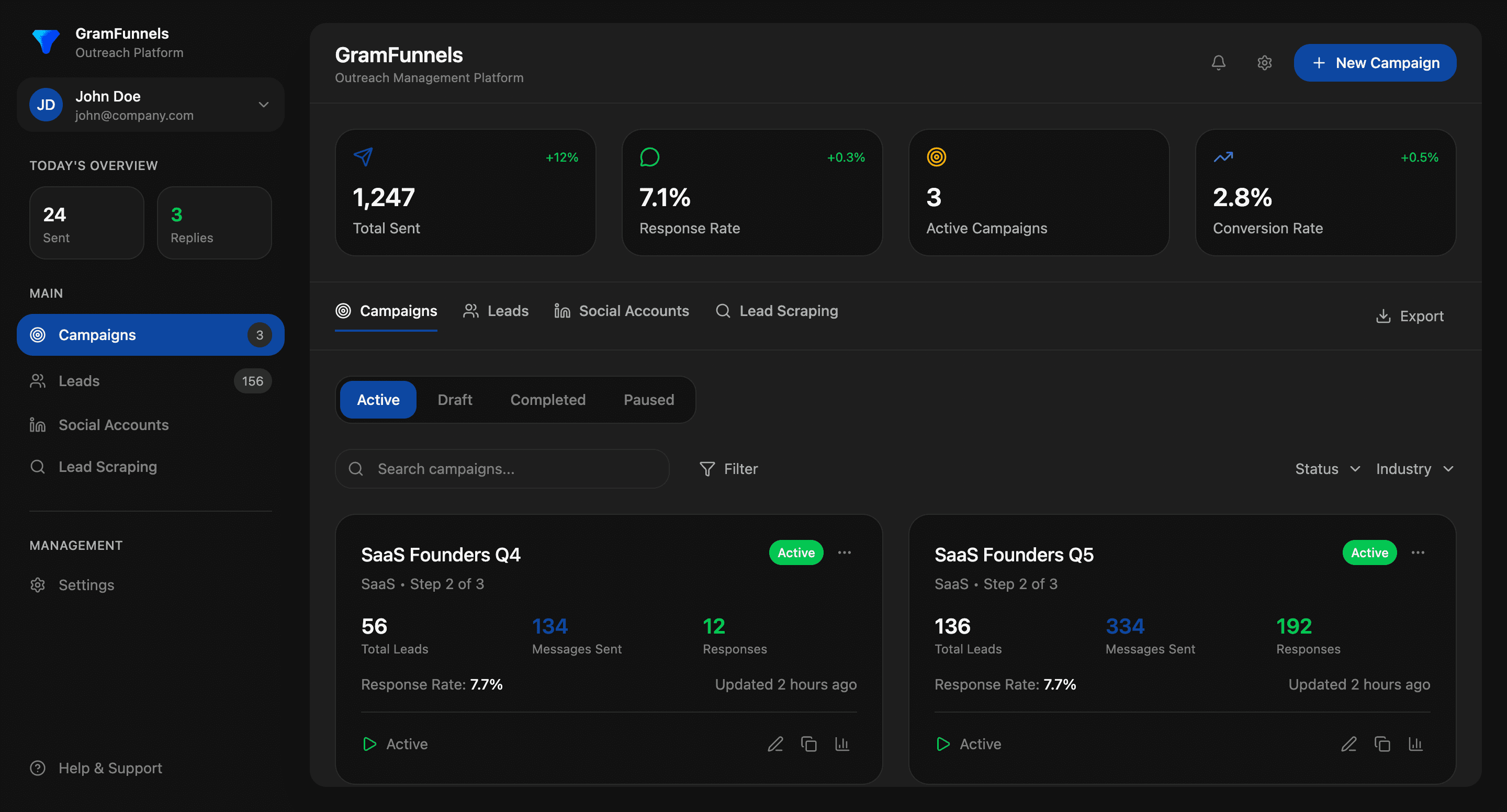
Solutions like GramFunnels take a different approach to LinkedIn intent by mapping "demand surfaces"-identifying the actual conversations, posts, and engagement where prospects are showing live buying behavior. Instead of relying on LinkedIn's limited API, this methodology tracks over 300 specific intent signals across the platform to find prospects already discussing challenges, evaluating solutions, or engaging with competitor content.
Technographic and Install Base Providers
Some providers focus on identifying what technologies companies currently use, tracking when those technologies might be up for renewal or replacement, and monitoring for signals suggesting dissatisfaction or evaluation of alternatives.
This approach works well for replacement selling and competitive displacement, but less effectively for entirely new solution categories where there isn't existing technology to track.
Evaluating B2B Intent Data Providers
Not all intent data is created equal. The market includes dozens of providers with wildly different methodologies, data quality, and pricing models. Choosing the wrong provider can waste budget and erode sales team trust in intent signals.
Data Coverage and Relevance
The first question to ask any provider: how much relevant data do you actually have for my specific market? A provider with excellent coverage in the tech sector might have almost no useful signals for manufacturing or healthcare.
Request a sample of their data for your target accounts and ideal customer profile. How many of your target accounts appear in their database? How many show recent intent signals? How frequently do signals refresh?
Also assess topic coverage. If you sell a specialized solution, does the provider track research around your specific category, or only broader, less actionable topics?
Signal Quality and Accuracy
Volume without quality is noise. Some providers boast about billions of data points, but if those signals don't actually correlate with buying behavior, they're worthless for sales and marketing.
Ask providers for case studies or data showing how their intent signals correlate with actual conversions. What percentage of high-intent accounts eventually enter buying processes? How much do their signals improve over random outreach?
Request transparency about signal decay-how quickly do intent signals become stale? Intent from last week is valuable; intent from six months ago is probably irrelevant.
Integration and Usability
Intent data is only valuable if your team actually uses it. Evaluate how easily the provider's data integrates with your existing tech stack-CRM, marketing automation, sales engagement platforms, and ABM tools.
The best providers offer native integrations that automatically enrich your CRM records with intent data, trigger campaigns when accounts surge in intent, and surface relevant signals directly in the tools your team already uses daily.
Also consider the user interface and reporting. Can your team easily understand and act on the data? Or does it require data science expertise to interpret?
Compliance and Data Ethics
In an era of GDPR, CCPA, and increasing privacy regulations, how providers collect and handle data matters enormously. Ensure your provider operates compliantly in all markets where you do business.
Ask about their data collection methodology. Do they have proper consent mechanisms? Are they transparent with users about data collection? Do they comply with industry privacy standards?
Non-compliant data practices can expose your company to legal risk and reputational damage. It's not worth the risk.
Pricing and ROI
Intent data pricing varies dramatically. Some providers charge based on data volume, others by the number of accounts tracked, and others through flat subscription fees.
Calculate the potential ROI by considering: how many more qualified opportunities will this create? How much time will it save sales reps on unqualified prospecting? How much will conversion rates improve?
For most B2B companies, even modest improvements in pipeline generation and conversion rates justify significant investment in quality intent data. However, expensive data that nobody uses or that doesn't drive results is just wasted budget.
Implementing Intent Data in Your Sales and Marketing Strategy
Having access to intent data is just the starting point. The real challenge is operationalizing it effectively across sales and marketing teams.
Start With Clear Use Cases
Before implementing any intent data provider, define exactly how you'll use the data. Common use cases include:
- Account Prioritization: Help SDRs focus on accounts showing active buying signals rather than working through static lists alphabetically.
- Campaign Targeting: Build marketing campaigns specifically addressing the topics and challenges that high-intent accounts are researching right now.
- Personalized Outreach: Reference the specific content or topics that prospects have engaged with to create relevant, timely conversations.
- Competitive Displacement: Identify when existing customers or target accounts are researching competitors, triggering defensive or offensive plays.
- Expansion Opportunities: Spot when existing customers are researching solutions adjacent to what they've already bought from you.
For more on building an effective outbound sales strategy that leverages intent data, start with clearly defined plays for each use case.
Align Sales and Marketing
Intent data is most powerful when sales and marketing operate from the same insights. Marketing can create content and campaigns addressing exactly what high-intent accounts are researching. Sales can reference that same intent data to make outreach relevant and timely.
Establish shared definitions of what constitutes "high intent" and create agreed-upon processes for how each team responds to different intent signals. When marketing and sales coordinate around intent data, the entire revenue engine becomes more efficient.
Combine With Other Data Sources
Intent data shouldn't replace other qualification criteria-it should enhance them. The most effective approaches layer intent signals on top of firmographic fit, technographic data, and engagement history.
An account might show high intent, but if they're too small for your typical deal size or outside your target industries, they're probably still not worth pursuing. Conversely, a perfect-fit account showing even modest intent might warrant immediate attention.
Monitor and Optimize
Track which intent signals actually correlate with pipeline creation and closed deals. You'll likely discover that some signal types or topics are highly predictive while others are noise.
Continuously refine your intent thresholds and scoring models based on actual results. What seemed like strong intent might not convert, while seemingly weaker signals might consistently turn into opportunities.
The Future of B2B Intent Data
The intent data market continues to evolve rapidly, with several trends shaping its future:
AI-Powered Signal Analysis: Machine learning is making intent data more sophisticated, identifying complex patterns across multiple signal types that humans might miss. AI can now predict buying behavior weeks before traditional signals appear.
Real-Time Intent Activation: Rather than daily or weekly data refreshes, leading providers are moving toward real-time intent signals that trigger immediate actions. When a target account spikes in intent, your team knows within minutes, not days.
Broader Signal Coverage: Providers are expanding beyond traditional digital signals to incorporate signals from sales conversations, customer support interactions, product usage data, and even offline events.
Privacy-First Approaches: As regulations tighten, providers are developing methodologies that deliver valuable intent insights while respecting user privacy and maintaining compliance. Expect continued evolution in how data is collected and anonymized.
Integration Ecosystems: Intent data is becoming less about standalone platforms and more about intelligence that flows automatically through your entire revenue tech stack, surfacing the right insights at the right time in every tool your team uses.
For teams specifically focused on LinkedIn as a prospecting channel, understanding LinkedIn high intent signals will become increasingly sophisticated, moving beyond basic engagement metrics to true demand surface mapping.
Making Your Decision
Choosing a B2B intent data provider is not a one-size-fits-all decision. The right provider depends on your target market, sales model, team size, existing tech stack, and specific use cases.
Start by running pilots with 2-3 providers to evaluate data quality and team adoption. Most reputable providers offer trial periods or proof-of-concept engagements. Use these opportunities to validate that their data actually improves your pipeline and conversion rates.
Focus less on the size of the provider's database and more on the relevance and accuracy of their data for your specific needs. A provider with deep coverage in your exact market will outperform one with broader but shallower data every time.
Remember that intent data is a tool, not a magic solution. It still requires skilled sales and marketing execution to convert insights into revenue. The best intent data in the world won't help if your team doesn't know how to have relevant conversations with in-market prospects.
As you evaluate providers, also consider your overall approach to buyer intent software and how intent data fits into your broader sales intelligence strategy. Intent data should complement, not replace, other essential components like contact data, firmographic intelligence, and engagement tracking.
The B2B buying process has fundamentally changed. Buyers now control when and how they engage with vendors, completing most of their research independently before ever taking a sales call. In this environment, intent data isn't optional-it's essential for competing effectively.
The companies that win are those that can identify buying signals early, engage prospects at the right moment with relevant conversations, and move faster than competitors to build relationships with in-market accounts. The right B2B intent data provider gives you the intelligence to do exactly that.